
Card-Not-Present Fraud: Types, Statistics, Warning Signs, and Prevention

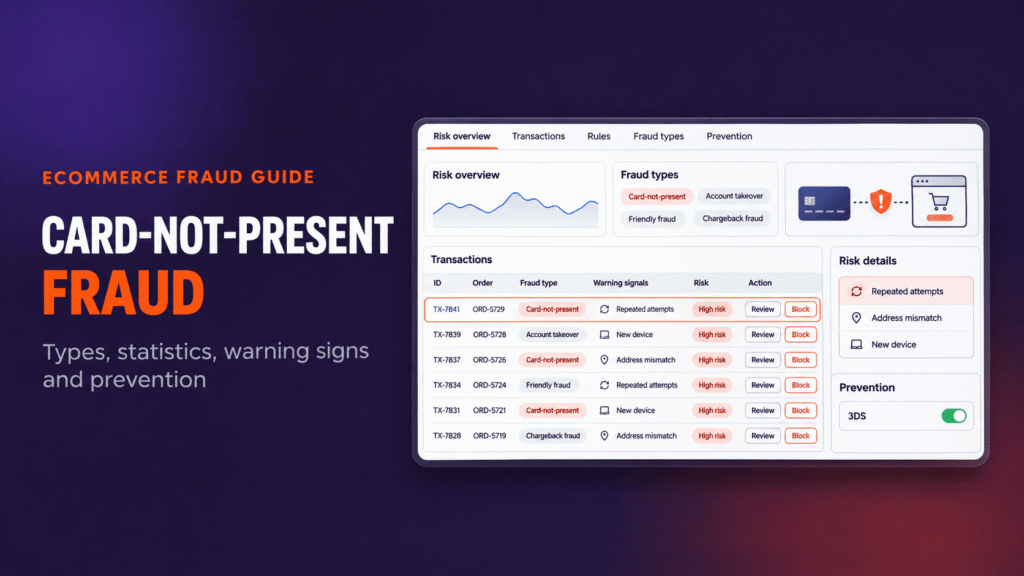
Card-not-present fraud happens when someone uses stolen card details to make a payment without showing the physical card. Because ecommerce merchants cannot check the buyer or card in person, they must rely on billing details, device data, authentication results, and checkout behavior to judge risk. Criminals may place one unauthorized order or use bots to test thousands of cards until one works. Effective card-not-present fraud prevention therefore needs several layers: secure payment processing, customer authentication, order review, bot controls, and a fast response plan. Together, these checks help stop suspicious activity without adding unnecessary friction for genuine customers.
What Is Card-Not-Present Fraud?
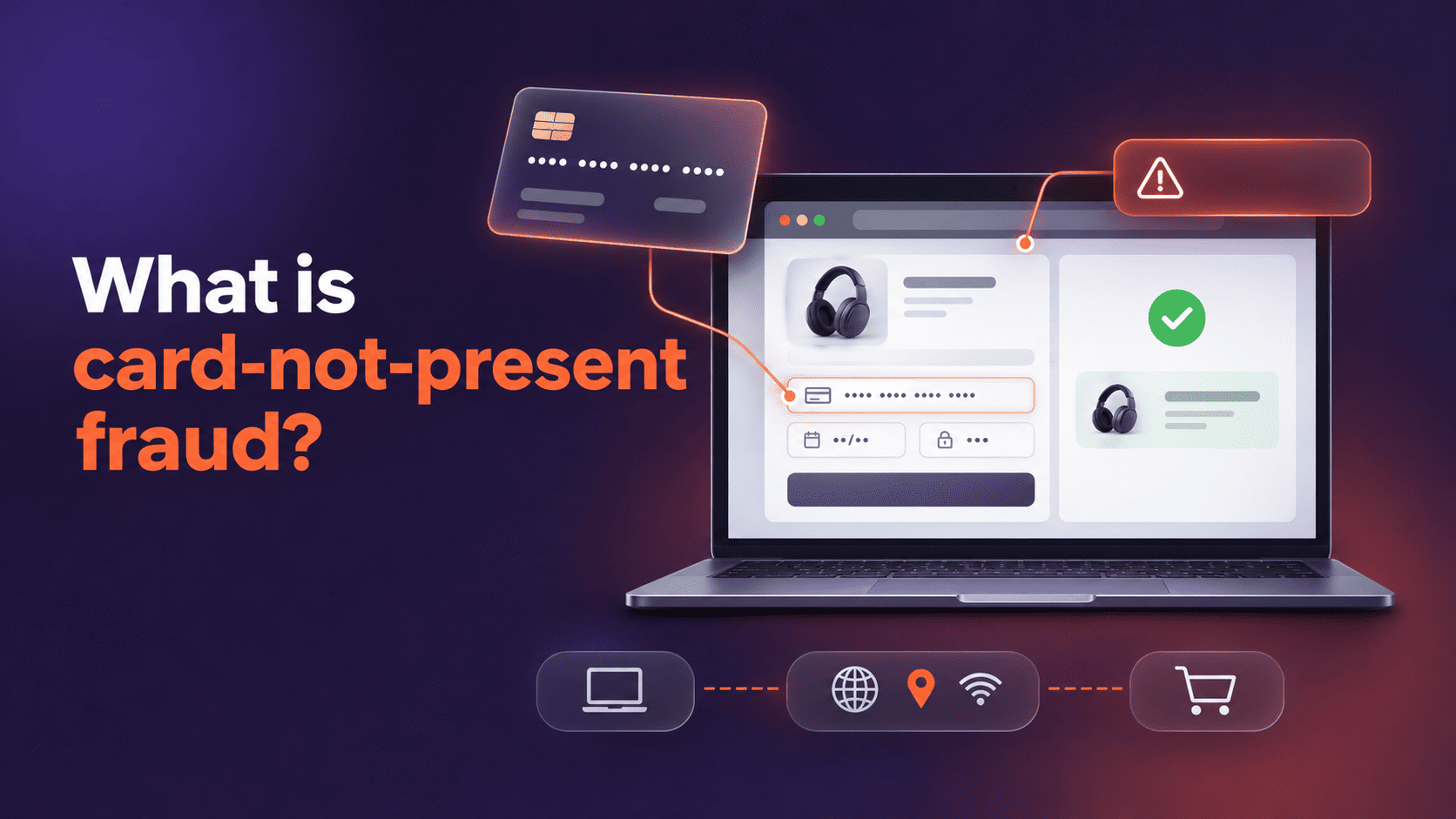
A card-not-present, or CNP, payment is made when the merchant cannot physically inspect the card. Online checkout is the most familiar example, but phone orders, mail orders, in-app payments, recurring billing, and some stored-card transactions can also fall into this category.
A CNP transaction is not automatically suspicious. It is simply a payment channel. Card not present transaction fraud occurs when a person uses that channel without the cardholder’s permission or later abuses the dispute process.
The difference from card-present fraud is the evidence available at payment. At a physical terminal, the card may generate a chip cryptogram and the buyer may enter a PIN. Online, the merchant normally relies on:
- Card number, expiry date, and card verification value
- Billing and shipping details
- Device, browser, network, and IP information
- Customer account and order history
- Transaction amount, products, and checkout behavior
- Authentication results from tools such as EMV 3-D Secure
Each signal answers only part of the question. A correct CVV does not prove that the buyer is the cardholder, while a mismatched address does not prove fraud. CNP decisions work best when several signals are evaluated together.
Card-not-present fraud versus card testing
Card testing is one form of CNP fraud, not a synonym for the whole category. In a card-testing attack, criminals submit stolen card details through a payment form to learn which cards are still active. The attacker may make a very small purchase, attempt a zero-dollar authorization, or try to save the card as a payment method.
Automation makes this especially damaging. A bot can try many cards quickly, rotate IP addresses, and change contact details. Most payments may fail, yet the store still receives declined authorizations and fake checkouts. A successful test can later support a larger fraudulent purchase.
For a deeper look at this attack pattern, read Blockify’s guide to card testing fraud and how to stop it.
How Does a Card-Not-Present Fraud Attack Work?
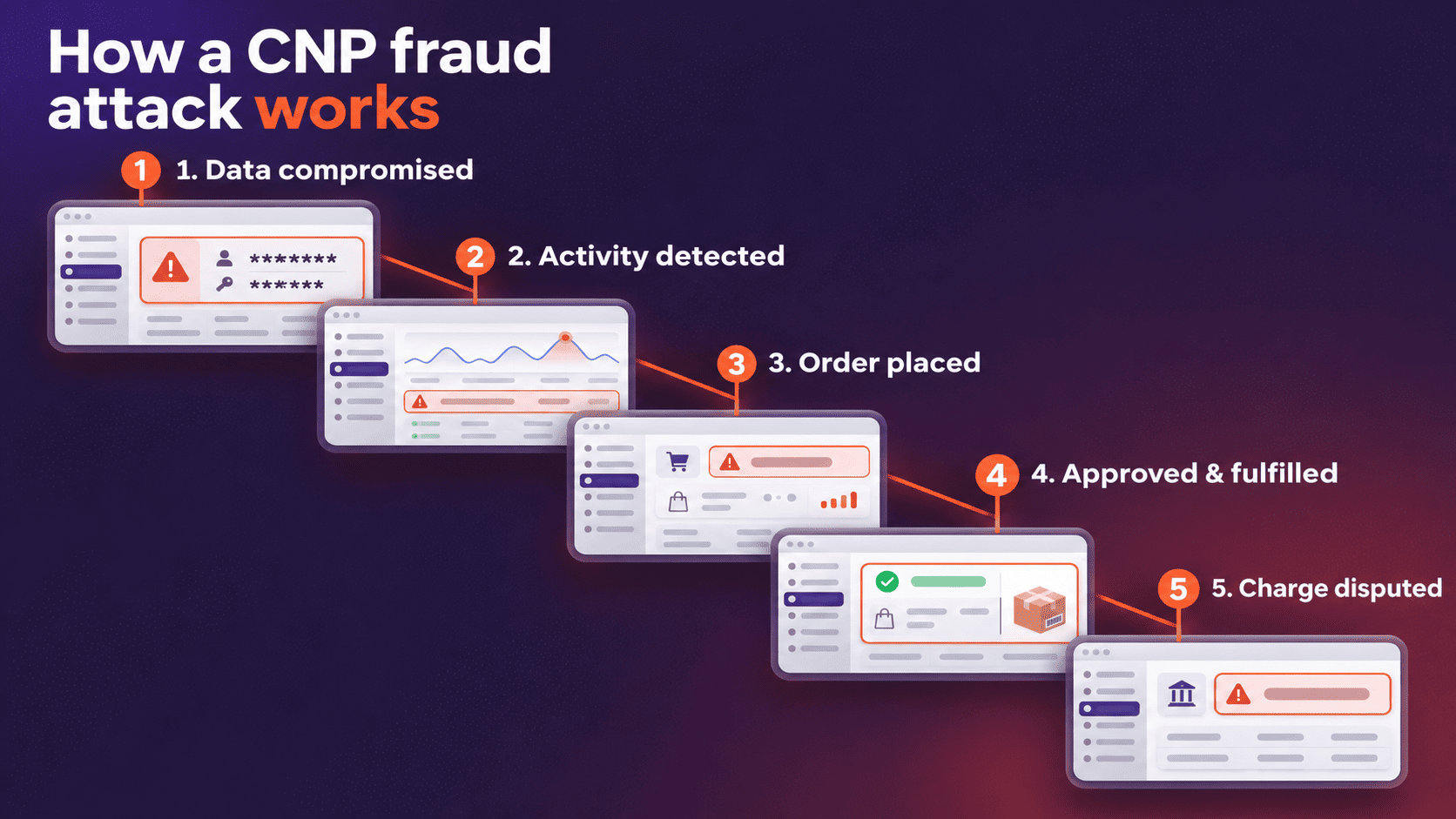
The details vary, but many attacks follow the same basic path.
1. The criminal obtains payment or account data
Card details may come from phishing, malware, a data breach, an insecure payment page, account takeover, social engineering, or an illegal marketplace. Some records contain only a card number and expiry date; others include a billing address, CVV, login credentials, or personal information.
2. The data is checked or enriched
An attacker may run card-testing attempts against a weak checkout or combine the card record with other stolen data. This creates warning signs such as rapid low-value attempts, many declines, repeated contact details, or many cards submitted from one device.
3. A fraudulent order is placed
Once the criminal finds a card that appears valid, they may buy easy-to-resell products, digital goods, gift cards, or high-value items. Account takeover can make the order harder to identify because a saved address and order history may look more trustworthy than a new checkout.
4. The merchant approves and fulfills it
Authorization means the issuer approved the payment at that moment. It does not guarantee that the cardholder made it. If the order is fulfilled, the merchant may lose both the product and payment when the cardholder reports it.
5. The cardholder disputes the charge
The merchant can receive a chargeback, lose the payment, pay an applicable fee, and spend time gathering evidence. Liability depends on the network, provider, authentication result, dispute reason, and local rules.
Common Types of Card-Not-Present Fraud
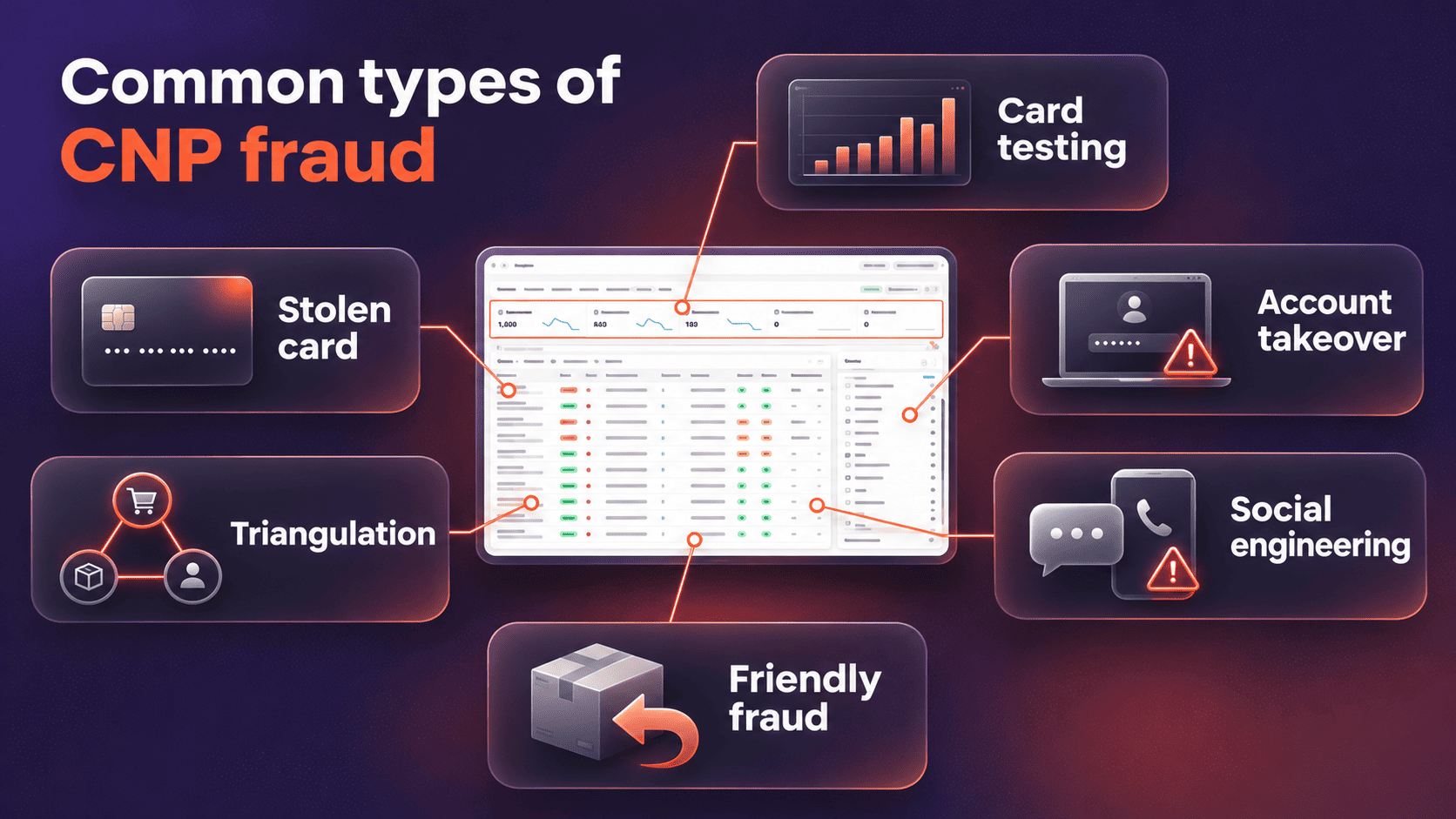
Understanding the attack matters because the right control depends on the route the criminal used.
Stolen card fraud
The buyer uses stolen card credentials to make an unauthorized purchase. Risk signals can include mismatched location, unusual device activity, a risky email, or an order pattern that does not fit the customer.
Card testing and enumeration
Bots submit many card records to discover which credentials are valid. Cheap products and direct-to-checkout routes give them a fast, low-cost response. Velocity controls, bot detection, and repeated-detail rules matter here.
Account takeover
The criminal enters a real customer account and uses a stored card, loyalty balance, or saved address. A correct password does not prove that the customer is present. New devices, unusual locations, rapid profile changes, and a last-minute address change can expose the takeover.
Triangulation fraud
A criminal takes money from a shopper, then buys the item from a legitimate merchant with a stolen card. The merchant ships to an innocent shopper, so the delivery details look genuine even though the payment is fraudulent.
Social-engineering-assisted CNP fraud
Criminals may trick a cardholder into sharing a one-time passcode or approving an authentication request. UK Finance reports that criminals use social engineering to obtain one-time passcodes, which they use to approve fraudulent payments or register stolen cards in digital wallets.
First-party misuse and friendly fraud
Sometimes the cardholder or someone in the household makes the purchase, then disputes it as unauthorized. Delivery proof, customer communication, login history, and clear billing descriptors are more useful here than IP blocking alone.
What Do Recent Card-Not-Present Fraud Statistics Show?
Fraud reports use different markets, payment types, and definitions, so their numbers should not be combined into one global rate. Read each figure with its geography and time period attached.
| Market and period | What the data shows | Why it matters |
|---|---|---|
| EU/EEA, 2024 | Remote payments were 28% of card value but 83% of card-fraud value. Their value-based fraud rate was 0.091%, 13 times the non-remote rate. | Remote payments carried a disproportionate share of fraud share. |
| Australia, July 2024-June 2025 | CNP fraud on Australian-issued cards totaled about A$746 million, roughly 87% of reported card-fraud value. | CNP remained the dominant category; the overseas rate was over ten times the domestic rate. |
| United Kingdom, 2025 | Remote purchase losses reached £423.5 million, up 3%, while cases rose 13% to about 3.2 million. | Cases grew much faster than losses. |
| United States, 2023 debit-card data | CNP rates rose across the networks studied. On single-message networks, the merchant loss rate increased from 5.4 basis points in 2021 to 12.8 in 2023. | Merchant exposure more than doubled in that segment. |
The 2025 EBA and ECB payment fraud report also found that card transactions without Strong Customer Authentication had higher fraud rates than authenticated transactions. Within the EEA in 2024, non-SCA card transactions had twice the fraud rate of SCA transactions by both value and volume. The gap was wider for transactions acquired outside the EEA.
The latest figures from AusPayNet, UK Finance, and the Federal Reserve Bank of Kansas City reinforce the same practical lesson: CNP fraud is not a rare edge case, but the rate and attack pattern differ by market and payment flow.
Why Does Card-Not-Present Fraud Cost More Than the Order Value?
The visible loss is the payment, but the operational cost is broader.
- Lost products or services: A fulfilled physical order may be unrecoverable. Digital products can be copied or consumed before the dispute arrives.
- Chargebacks and fees: The merchant may lose the payment and pay a dispute fee, depending on the provider and outcome.
- Payment processing pressure: A fraud or card-testing spike can lead to tighter monitoring, reserves, or other action by a processor or network.
- Manual review time: Staff must inspect orders, contact customers, document evidence, and cancel suspicious orders.
- Polluted analytics: Fake checkouts can distort conversion rates, abandoned-cart data, campaign reporting, and demand signals.
- False declines: Rules that are too aggressive reject real customers. That lost revenue is harder to see because no order is created.
A $1 card test is not only a $1 problem. It can create authorization traffic, cleanup work, a dispute, and a negative signal about the merchant’s payment environment.
What Are the Warning Signs of CNP Fraud?
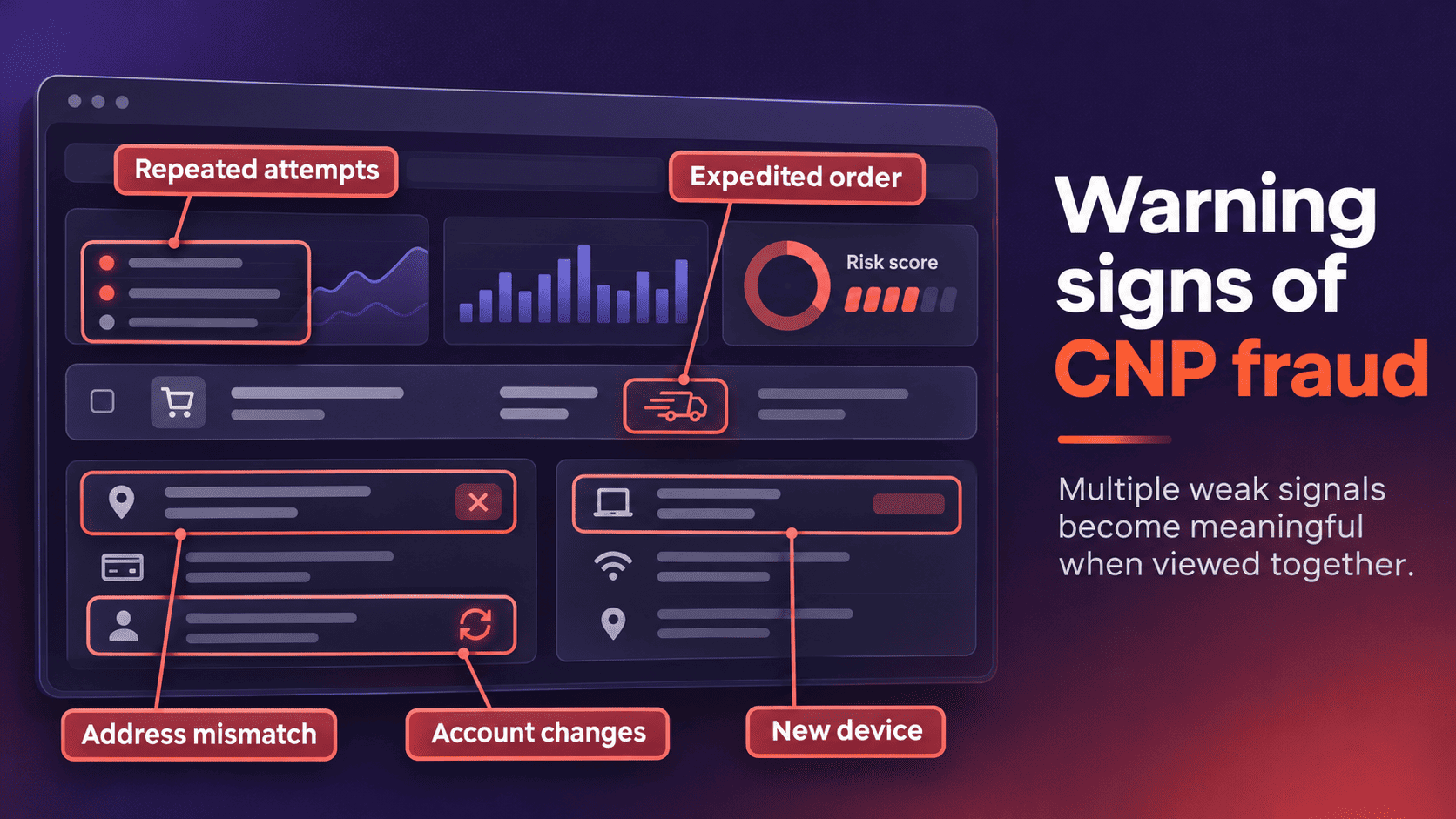
One unusual order is not proof. Look for clusters of signals and changes from normal behavior.
Payment and checkout signals
- A sudden increase in declines or failed authorizations
- Many cards attempted from the same device, session, IP, email, address, or customer account
- Repeated checkouts within seconds or minutes
- Many small orders for the cheapest product
- Zero-subtotal or low-value checkouts that do not match normal buying behavior
- Several cards used before one payment succeeds
Identity and location signals
- IP location, billing country, and shipping country do not make sense together
- A new account immediately places an unusually large or urgent order
- Disposable email addresses, placeholder names, or repeated phone numbers
- A customer account changes its password, email, address, and payment details just before ordering
- VPN, proxy, Tor, or data-center traffic appears alongside other suspicious behavior
A privacy connection alone is not proof of fraud. Treat VPN, proxy, or data-center use as one signal, not an automatic verdict.
Order and fulfillment signals
- Rush shipping on an unusually valuable order
- Multiple orders sent to one address under different identities
- A billing address that passes basic checks while the shipping behavior remains unusual
- Orders for gift cards, digital goods, limited-stock items, or products that can be resold quickly
- A customer who resists reasonable verification or repeatedly changes delivery instructions
On Shopify, fraud analysis indicators can include AVS and CVV results, customer location, device or network activity, and the use of multiple cards. They support review; they are not independent proof of fraud.
How to Prevent Card-Not-Present Fraud Without Blocking Good Customers
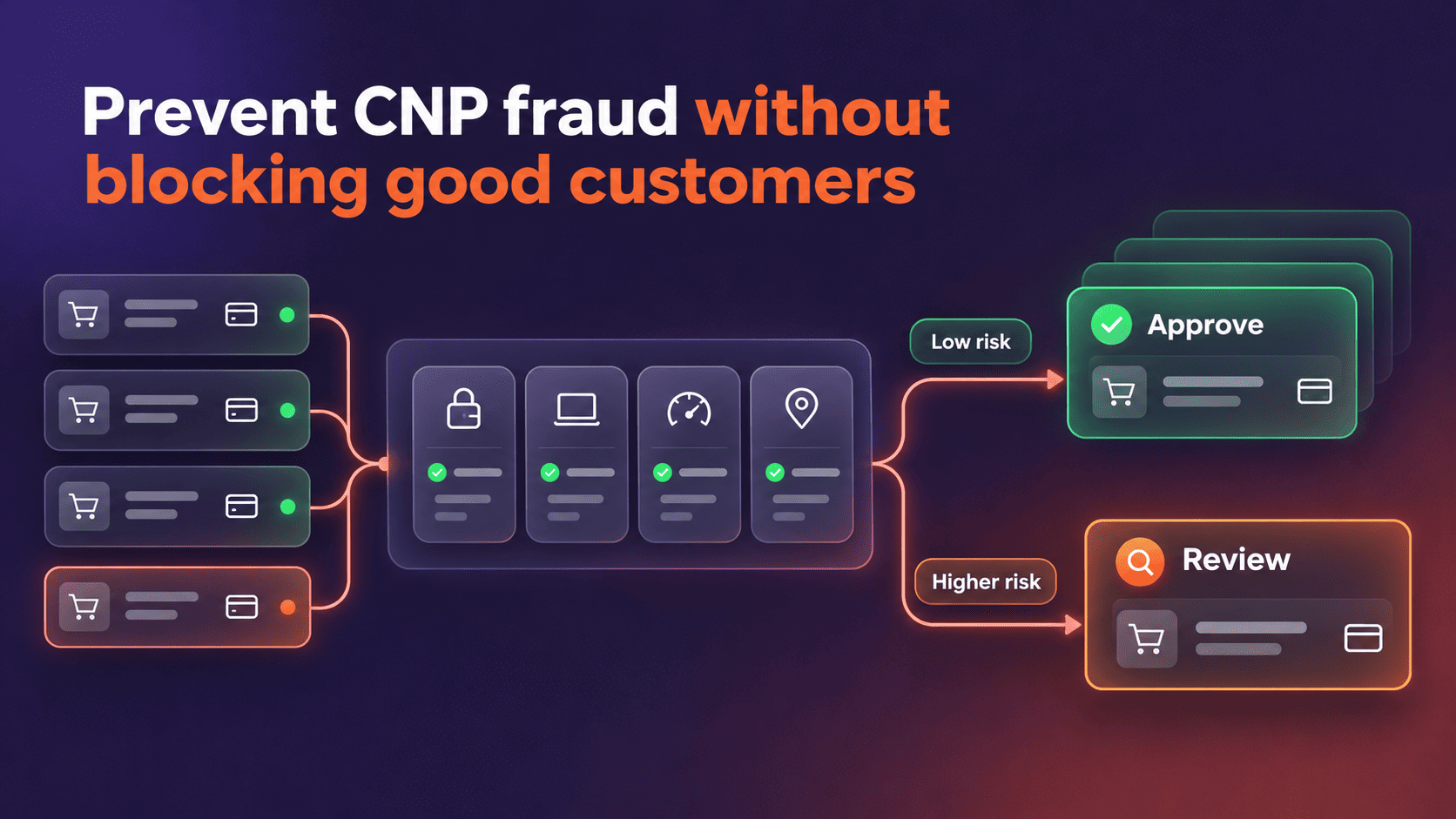
The strongest approach adds controls at several points: before payment, during authentication and authorization, before fulfillment, and after the order.
1. Use EMV 3-D Secure and risk-based authentication
EMV 3-D Secure lets the merchant, issuer, and customer exchange information and authenticate an ecommerce transaction. Low-risk payments may pass through a frictionless flow, while higher-risk payments trigger a challenge.
EMVCo describes EMV 3DS as a way to help prevent CNP fraud and improve ecommerce security. Authentication can affect liability for some disputes, but rules vary by network, region, transaction, and result. Do not assume every 3DS payment shifts liability.
Apply challenges based on risk where the payment setup allows it. Challenging every customer can add avoidable friction; never challenging anyone leaves a gap.
2. Check CVV and AVS results in context
CVV helps confirm that the buyer knows the security code printed on the card. AVS compares the numeric billing-address details with the issuer’s records. A mismatch can justify an extra check, but neither tool should make the whole decision.
Address formats, gifts, travel, and recent moves can create legitimate mismatches. Approve low-risk matches, review mixed signals, and decline only when the complete pattern supports it.
Never store a CVV after authorization. The PCI Security Standards Council classifies card verification codes as sensitive authentication data and prohibits storing them after authorization, even when encrypted.
3. Score the transaction using several signals
A useful risk model combines order value, product risk, customer history, device, IP, shipping behavior, velocity, account changes, and authentication results.
Create different paths instead of a simple approve-or-decline rule:
- Approve when the signals are consistent and risk is low.
- Add authentication when uncertainty is manageable.
- Hold for review when the order is valuable and the evidence is mixed.
- Decline when several strong risk signals align.
A rigid rule, such as blocking every billing-and-shipping mismatch, can reject gift buyers and travelers along with fraudsters.
4. Add velocity limits and bot controls
Velocity measures how often an action occurs. Useful limits include attempts per card, device, account, email, phone number, address, or IP range.
Do not rely on IP alone. Distributed bots rotate addresses. A repeated identity detail across many IPs can be more revealing than any one network address.
Use CAPTCHA or a step-up challenge when behavior looks automated. Protect account creation, login, password reset, gift-card balance checks, card-saving endpoints, and checkout.
5. Remove easy card-testing routes
Review how cheaply and quickly a bot can reach payment. Free products, $0 checkouts, low-price items, direct cart links, and unrestricted payment-method attachment can become testing tools.
Compare suspicious activity with real customer behavior. A minimum order rule may suit a wholesaler but harm a store that sells samples or small accessories.
6. Review high-risk orders before fulfillment
Authorization is not a final fraud decision. Add a short hold for orders that meet defined review criteria, especially high-value, expedited, digital, or easy-to-resell purchases.
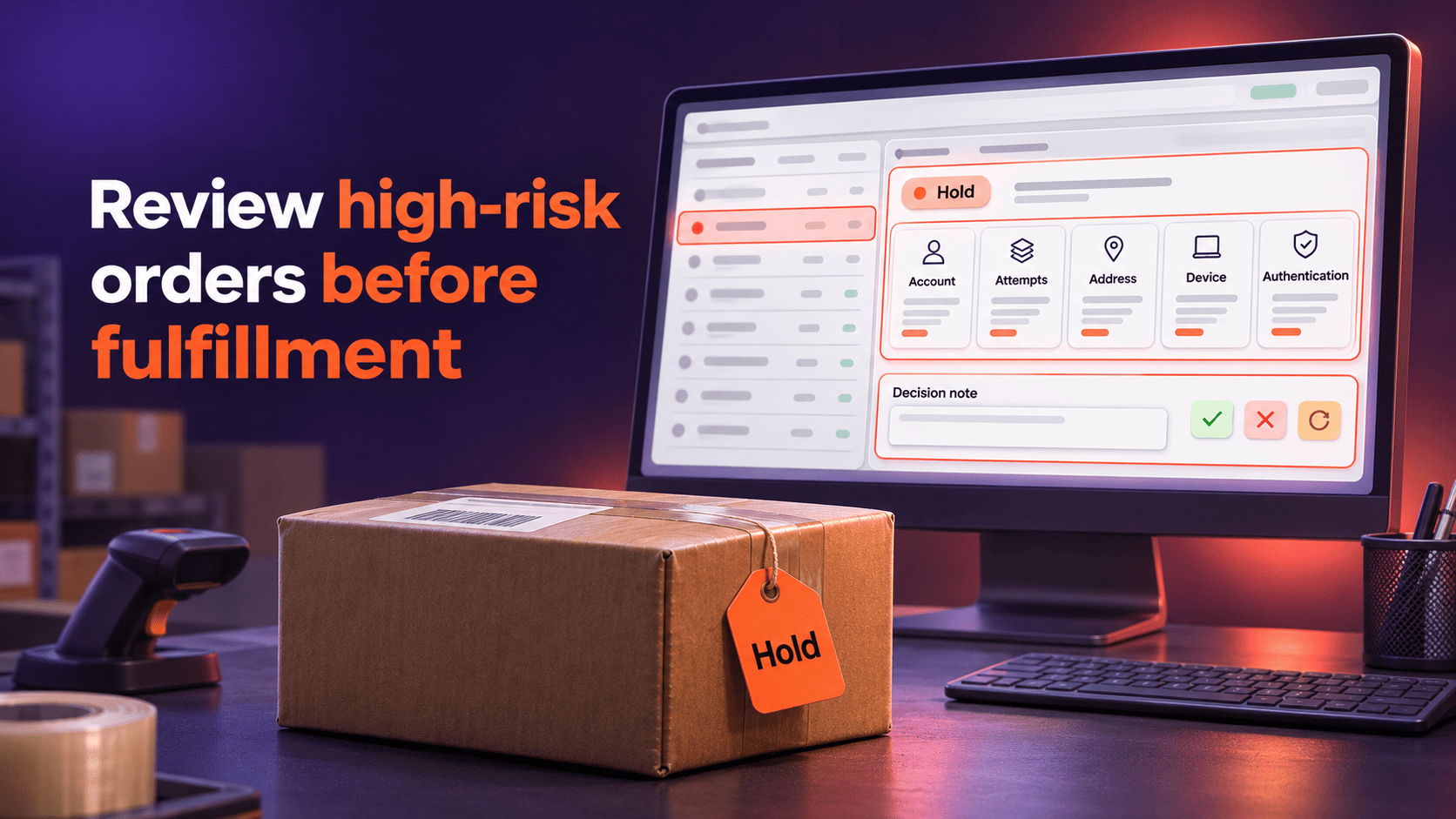
Review account changes, payment attempts, address, device and network signals, and authentication results. Never request sensitive card data by email or chat.
Document why an order was approved, canceled, or refunded. These notes help refine rules and answer later disputes.
7. Protect payment data and the payment page
Use a PCI DSS-compliant payment provider, reduce systems that handle raw card data, update software and apps, control administrative access, and monitor payment-page changes.
PCI DSS provides baseline requirements for entities that store, process, transmit, or can affect payment account data. PCI SSC’s 2025 payment-page guidance focuses on authorizing payment-page scripts, checking their integrity, and detecting tampering that could lead to e-skimming.
Tokenization replaces the primary account number with a constrained token. It does not replace transaction monitoring, but it reduces exposure to raw card data.
8. Measure fraud and false declines together
Track approval rate, manual-review rate, false positives, fraud loss by channel, authentication rate, checkout conversion, card-testing attempts, and response time.
Segment results by market, payment method, device, customer type, product, and order value. One threshold rarely fits every segment.
Review rules after promotions, product launches, and attack spikes. Fraud patterns change, but customer behavior also changes. A threshold based on last month’s normal traffic may fail during BFCM or a viral campaign.
How Blockify Helps Protect Shopify Checkout from Card-Testing Bots
Card-testing bots rarely behave like genuine shoppers. Instead of browsing product pages, many skip the storefront and open a checkout link directly so they can test stolen cards faster. Others create repeated checkouts using the same email, address, phone number, or name. These behaviors are useful warning signs because they reveal how the checkout is being abused.
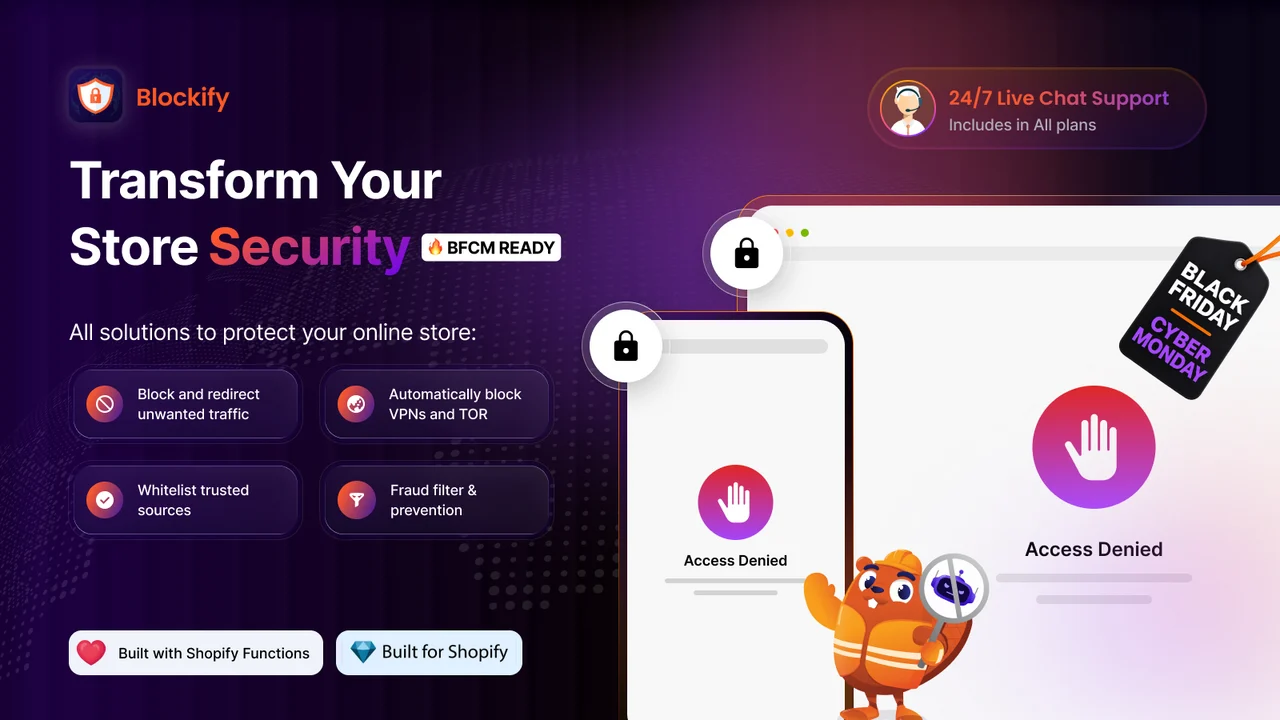
Blockify Fraud Filter helps Shopify merchants respond to these patterns before they turn into completed orders:
- Stop fake checkouts that bypass the storefront: Blockify can stop checkouts that do not begin through the normal storefront journey. This targets the shortcut used by direct-to-checkout bots without interrupting the path genuine shoppers normally follow.
- Limit repeated checkout details: Merchants can set hourly limits for checkouts that reuse the same email, address, phone number, or name.
- Apply checkout blocking rules: Rules can respond to conditions involving email, address, country, IP, or VPN use. Built-in options also cover patterns such as $0-subtotal checkouts and disposable email addresses.
- Control bots on the storefront: Spam-bot and user-agent rules can restrict harmful automation, while an allowed list keeps legitimate crawlers accessible.
- Review the pattern before blocking widely: Analytics help merchants examine risk signals and repeated low-value activity before tightening their rules.
These controls work best when they reflect how the store normally sells. A country allowlist may suit a merchant that ships to only a few markets, while a minimum cart value may make sense for a wholesaler. The same settings could block genuine revenue for a global store that sells inexpensive products.
Blockify should therefore be used as one layer in a wider CNP fraud strategy. It can close common routes used by card-testing bots before or around checkout, but it does not replace 3-D Secure, AVS and CVV checks, payment-provider fraud tools, secure card-data handling, or order review.
Final Words
Card-not-present fraud will keep changing, but the goal remains simple: make checkout difficult to abuse without making it difficult to buy. That means watching how real customers behave, tightening controls when new risks appear, and adjusting them as the store grows. For Shopify merchants facing automated checkout abuse, Blockify can help close the routes card-testing bots depend on before fake attempts become a larger payment problem.
