
Telecommunications Fraud Exposed: Inside the Tactics Draining Billions

Telecommunications fraud costs the industry billions every year, and the tactics keep shifting faster than most detection systems can keep up. From SIM swaps to IRSF, understanding how telecom fraud actually works is the first step toward stopping it.
| What you’ll learn in this article: ● What Is Telecommunications Fraud? ● What Are the Most Common Types of Telecom Fraud? ● How Does Telecom Fraud Detection Work? ● Best Practices to Prevent Telco Fraud |
What Is Telecommunications Fraud?
Telecommunications fraud refers to any act that exploits phone networks, billing systems, or telecom infrastructure for illegal financial gain.
Fraudsters typically target three weak points: network vulnerabilities that allow unauthorized call routing access, billing loopholes that generate revenue through inflated call volumes, and identity gaps that let criminals hijack or open accounts using stolen credentials.
The scale of the problem keeps growing. Juniper Research estimates that consumer losses to mobile messaging fraud (including smishing and account takeover) reached $80 billion globally in 2025, with phone-based scams remaining among the most prevalent tactics.”
As fraud tactics keep evolving, understanding how these schemes work becomes the first step toward building an effective defense.
What Are the Most Common Types of Telecom Fraud?
Fraudsters use several distinct methods to exploit telecom networks and billing systems. Each type targets a different weak point, from stolen identities to hijacked network infrastructure.
Subscription Fraud
Criminals open new accounts using stolen or fake identities. They rack up service charges, then vanish before the bill arrives. Providers absorb the loss since the account never had a legitimate paying customer behind it.
SIM Swap Fraud
Attackers convince a carrier to transfer a victim’s phone number to a new SIM card. Once the swap happens, they intercept calls and SMS-based verification codes. Consequently, they gain access to banking apps and other accounts tied to that number.
Wangiri Fraud
Fraudsters place brief, one-ring calls to random numbers, hoping victims call back. The return call connects to a premium-rate number that charges heavily per minute. “Wangiri” translates to “one ring and cut” in Japanese, reflecting how quickly the scam call disconnects.
IRSF (International Revenue Share Fraud)
Criminals hack into a company’s phone system, then route large volumes of calls to premium international numbers they control. Each call generates revenue that gets split between the fraudster and a complicit international carrier. Losses can accumulate within hours, often over a single weekend when nobody monitors the account.
PBX Hacking
Attackers exploit weak passwords or outdated software in a business’s private phone system. Once inside, they use the compromised PBX to make expensive international calls at the company’s expense. Small and mid-sized businesses face the highest risk, since many lack dedicated IT security staff.
SIM Box Fraud
Fraudsters route international calls through local SIM cards instead of legitimate international gateways. This bypasses interconnect fees that carriers normally charge for cross-border traffic. As a result, telecom providers lose revenue while the call still appears to originate locally.
Account Takeover & Identity Fraud
Criminals use stolen credentials or social engineering to gain control of an existing customer account. From there, they can order new devices, change service plans, or access personal data tied to the account.
CLI Spoofing
Fraudsters manipulate the caller ID information displayed on a recipient’s phone, making calls appear to come from a trusted organization, government agency, or local number. The fake identity increases the likelihood that victims will answer the call and disclose sensitive information or authorize fraudulent payments.
Smishing (SMS Phishing)
Attackers send fraudulent text messages that appear to come from legitimate organizations, such as banks, delivery services, or telecom providers. These messages typically contain malicious links or urgent requests designed to trick recipients into revealing login credentials, financial information, or one-time verification codes.
How Does Telecom Fraud Detection Work?
Modern fraud detection relies on layered systems that watch network activity around the clock. No single method catches everything, so providers combine several approaches.
Real-Time Monitoring of Network Events
Detection systems track call setups, SMS activity, and data sessions as they happen. Unusual spikes in call volume or destination patterns trigger immediate alerts. Speed matters, since fraud like IRSF can generate massive losses within hours.
CDR (Call Detail Record) Analysis
Every call generates a record containing the caller, recipient, duration, and destination. Systems scan these records for patterns that don’t match normal behavior. A sudden burst of calls to premium-rate numbers often signals PBX hacking in progress.
AI and Machine Learning for Anomaly Detection
Machine learning models learn what normal usage looks like for each account. They then flag deviations that a fixed rule might miss. This approach adapts as fraud tactics shift, which matters since fraudsters constantly change methods to avoid detection.
Rule-Based vs AI-Powered Detection
Rule-based systems flag activity that breaks a set threshold, like too many calls in one minute. This works well for known patterns but struggles against new or disguised schemes. AI-powered detection catches subtler anomalies without a predefined rule. Most providers run both together, using rules for speed and AI for depth.
Key Fraud Detection Metrics
Providers track a few core metrics to measure detection performance. False positive rate shows how often legitimate customers get flagged by mistake. Detection latency measures how fast the system catches fraud after it starts. Fraud loss ratio, meanwhile, tracks total losses against revenue, giving leadership a clear view of financial exposure.
What Is Telecom Fraud Management?
Telecom fraud management is the end-to-end process that turns fraud detection alerts into resolved cases. Detection alone only flags suspicious activity, but management ensures each alert gets investigated, acted on, and documented properly.
A complete fraud management program typically covers:
- Detection of suspicious activity across the network
- Investigation to confirm whether an alert is genuine fraud
- Automated response to stop losses in progress
- Case management to track every incident through resolution
- Reporting and compliance to satisfy regulators and internal audits
Best Practices to Prevent Telco Fraud
I’ve watched too many fraud programs fail for the same reason: they buy detection tools and stop there. Detection catches fraud after it starts. Prevention stops it before it costs a dollar.
Identity Verification
Weak onboarding is where most fraud programs quietly bleed money, and nobody notices until the bad debt report lands on someone’s desk months later. According to the CFCA Global Fraud Loss Survey 2025, subscription fraud involving true or stolen identities remained the costliest telecom fraud category, causing an estimated $5.31 billion in losses worldwide.
A single form field asking for a name and address won’t catch a synthetic identity. Document verification, liveness checks, and cross-referencing against known fraud databases at the point of sale close most of that gap. If your fraud team only reviews accounts after they’ve been active for 30 days, you’re already too late.

Multi-Factor Authentication
I’ve seen carriers push back on MFA because it adds friction to the login flow. That tradeoff is almost never worth it. Microsoft’s research found MFA cuts the risk of account compromise by 99.22% overall – and still by 98.56% when the password has already leaked.
For telecom specifically, this matters most on the self-service portal, since that’s where SIM swap and account takeover attempts actually happen. Push-based or app-based MFA beats SMS codes here too, since SMS itself can be intercepted through the very SIM swap you’re trying to prevent.
Real-Time Risk Scoring
A static rule catches yesterday’s fraud pattern. Risk scoring catches today’s. I’ve found the highest-value signals aren’t exotic: device fingerprint mismatches, a login from a new country immediately followed by a plan change, or a customer requesting a SIM swap right after a password reset.
Score these in real time and route anything above a threshold to manual review before the change completes, not after.
AI-Driven Behavioral Analytics
Rules eventually get reverse-engineered by fraudsters who test your thresholds directly. Behavioral models are harder to game because they learn what’s normal for each account rather than applying one fixed line for everyone.
The catch: these models need clean historical data to train on. If your CDR data is fragmented across legacy systems, invest in cleaning that pipeline first, since a behavioral model built on bad data produces false confidence, not protection.
Continuous Network Monitoring
IRSF losses can hit six figures over a single unmonitored weekend. I’ve seen it happen more than once, always outside business hours when nobody was watching the dashboard. Round-the-clock monitoring with automated alerting, not a shift-based manual review, is the only way to catch this before Monday morning.
Employee Training & Fraud Awareness
Every technical control in this list can be undone by one support agent who gets socially engineered into approving a SIM swap over the phone. Fraudsters specifically target call centers because they know a stressed, rushed agent is easier to manipulate than a firewall.
Regular, scenario-based training, not a once-a-year slide deck, is what actually changes behavior when a convincing scammer calls in claiming to be a panicked customer.
How to Choose the Right Telecom Fraud Detection Solution
Picking a fraud detection platform is a long-term commitment, not a one-time purchase. The wrong choice means retraining teams and migrating data again within a year.
Must-Have Features
A capable platform should cover the fundamentals before anything else matters:
- Real-time detection across voice, SMS, and data traffic, not batch processing that runs hours later
- Both rule-based and AI-driven detection working together, not one or the other
- Case management built in, so investigations don’t require exporting data into a separate tool
- Configurable risk scoring that adapts to your specific customer base and traffic patterns
- Compliance-ready reporting that maps to regulatory requirements in your operating markets

Questions to Ask Vendors
The sales pitch rarely reveals what matters most. Ask these directly instead:
- What’s your actual false positive rate in production, not in a lab demo?
- How fast does the system detect and respond to an IRSF attack in progress?
- Can the platform integrate with our existing CDR and billing systems without custom development?
- How often does the model retrain, and who’s responsible for tuning it after deployment?
- What happens during a network outage or data spike? Does detection degrade gracefully or fail silently?
A vendor who answers these with specifics, not marketing language, is usually the safer bet.
Future Trends
Fraud detection keeps evolving alongside network technology and fraudster tactics. A few developments are already reshaping how providers approach the problem.
GenAI
Generative AI now helps fraud teams summarize investigation findings and generate case reports automatically. It also powers more convincing social engineering attacks, which means fraud teams face a faster-moving adversary on both sides of the equation.
Graph Analytics
Graph-based models map relationships between accounts, devices, and phone numbers instead of analyzing each in isolation. This approach catches coordinated fraud rings that individual account monitoring would miss entirely.
Predictive Fraud Detection
Rather than reacting to fraud already in progress, predictive models flag accounts likely to turn fraudulent before the first incident occurs. This shifts the response from damage control to early intervention.
5G & IoT Fraud Protection
5G networks and the explosion of connected IoT devices introduce new attack surfaces that legacy fraud systems weren’t built for. Providers now need detection tuned specifically for machine-to-machine traffic patterns, which look nothing like typical human calling behavior.
How eCommerce Businesses Prevent Identity-Based Fraud
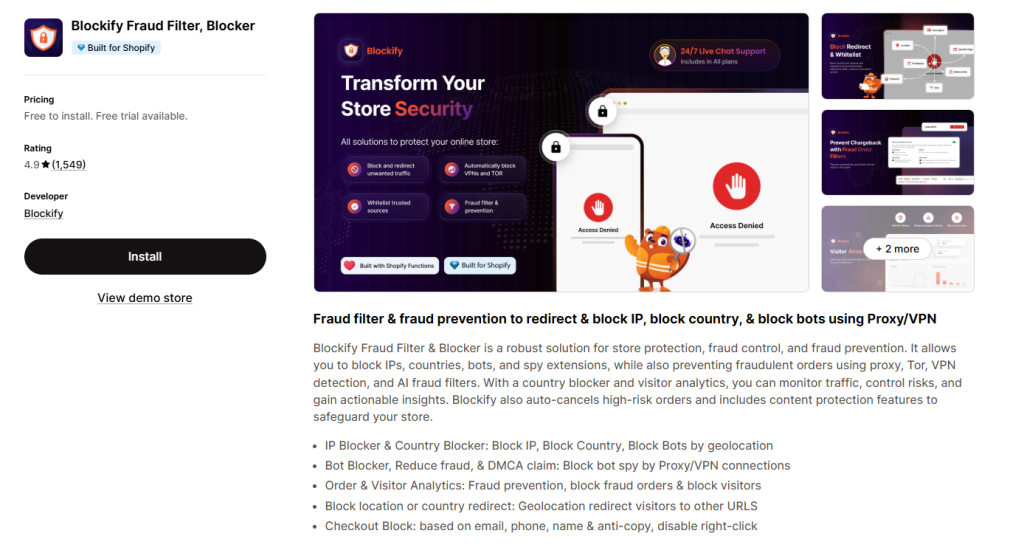
💡 Fraud prevention isn’t limited to telecom providers. Online merchants face similar identity-based attacks, including account takeover, VPN abuse, bot traffic, and stolen payment credentials. While telecom operators rely on network-level fraud detection, eCommerce businesses often use specialized fraud prevention solutions like Blockify Fraud Filter to automatically block high-risk visitors, VPNs, proxies, bots, and suspicious IP addresses before fraudulent transactions occur.
FAQs
Can telecom fraud be completely eliminated?
No single system stops every attempt. The realistic goal is shrinking the window between when fraud starts and when it gets caught.
Who is responsible for fraud losses, the carrier or the customer?
It depends on the fraud type and jurisdiction. Subscription fraud typically falls on the carrier, while identity-theft cases often trigger separate liability rules for the affected customer.
Does 5G make telecom fraud easier or harder to detect?
Both. Faster networks mean fraud can scale quicker, but they also generate richer data that detection systems can analyze in real time.
Conclusion
Telecommunications fraud isn’t a problem any single tool solves once and forgets. New fraud types emerge as fast as networks evolve, and the providers who stay ahead treat detection, management, and prevention as one continuous cycle rather than three separate projects.
The threat landscape will keep shifting, from GenAI-powered social engineering to fraud targeting 5G and IoT traffic. But the providers who treat telecommunications fraud prevention as an ongoing discipline, not a checkbox, are the ones who keep losses contained instead of explaining them after the fact.
