
Why Your Customer Risk Assessment Is Weaker Than You Think?

Customer risk assessment is a core requirement of any Anti-Money Laundering (AML) compliance program. It determines how much risk each customer carries, what level of due diligence to apply, and how closely to monitor the relationship over time.
| What you learn in this article: ● What Is Customer Risk Assessment in AML? ● What Factors Should Be Included in an AML Customer Risk Assessment? ● How Does the Customer Risk Assessment Process Work? ● How Are Customer Risk Levels Classified?Common Challenges and Best Practices for Customer Risk Assessment |
What Is Customer Risk Assessment in AML?
A customer risk assessment is the process a business uses to evaluate how likely a customer is to be involved in money laundering, terrorist financing, or other financial crimes. In practice, a compliance team gathers information about a customer and assigns them a risk level based on factors like who they are, where they operate, and how they use financial services.
Anti-money laundering (AML) regulations in most countries require businesses to conduct these assessments before onboarding a customer and to revisit them regularly over the course of the relationship. Without a structured risk assessment process, a business has no reliable way to decide how much scrutiny to apply to any given customer.
What Factors Should Be Included in an AML Customer Risk Assessment?
No single piece of information is enough to determine a customer’s risk level. Instead, a compliance team looks at several factors together to build a complete picture.
Customer Profile and Business Activities
The starting point of any risk assessment is understanding who the customer is and what they do. A compliance team looks at occupation, business type, ownership structure, and source of wealth.
A salaried employee with a predictable income carries a very different risk profile from a cash-intensive business or a privately held company with complex, multi-layered ownership. Generally, the harder it is to verify who ultimately controls the money, the higher the risk rating a customer receives.
Geographic and Jurisdiction Risk
Where a customer lives, operates, or sends money matters significantly in AML. Some countries have weak anti-money laundering controls, high levels of corruption, or active sanctions programs.
A customer connected to a country on the FATF grey list or black list, or a jurisdiction flagged by Transparency International’s Corruption Perceptions Index, automatically carries a higher base risk level. Cross-border activity involving offshore financial centers or banking secrecy havens adds another layer of concern on top of that.
Products, Services, and Delivery Channels
The type of product or service a customer uses also affects their risk profile. Some financial products are simply easier to misuse for money laundering than others.
Heavy reliance on cash, use of anonymous payment methods like prepaid cards, remote account access without in-person verification, and frequent cross-border wire transfers to high-risk jurisdictions all push a customer’s risk rating upward.
Transaction Behavior and Source of Funds
Even if a customer appears legitimate at onboarding, their actual transaction behavior over time can reveal red flags. The core question here is whether what a customer actually does matches what they said they would do.
Large cash deposits followed by immediate outbound transfers, transactions with no clear business purpose, or volumes that far exceed a customer’s stated income are all signs that something may not add up.
PEPs, Sanctions, and Adverse Media Screening
Three specific checks sit at the core of almost every AML customer risk assessment.
First, businesses must identify whether a customer is a Politically Exposed Person (PEP). FATF defines a PEP as an individual who is or has been entrusted with a prominent public function, a group that carries higher inherent risk of corruption and therefore requires enhanced due diligence.
Second, sanctions screening checks whether a customer appears on official lists maintained by bodies such as the UN, the EU, or OFAC. The consequences of missing a sanctioned customer are severe: in 2024, OFAC issued 12 enforcement actions totalling over $48.7 million in penalties against businesses and individuals that failed to comply.
Third, adverse media screening looks for negative news linking a customer to financial crime or serious misconduct. Official lists are updated periodically, but news moves faster, and adverse media screening closes that gap.

How Does the Customer Risk Assessment Process Work?
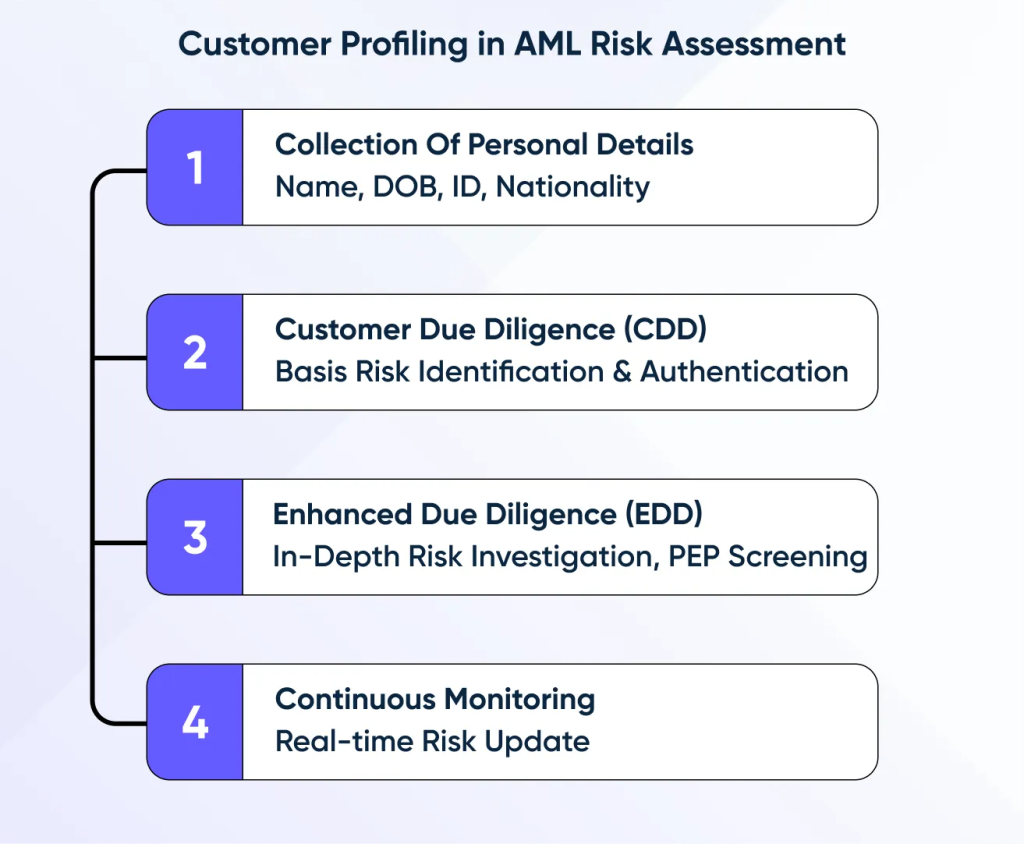
Most businesses follow a structured, step-by-step process to evaluate customer risk. Each step builds on the previous one, and together they form the foundation of a defensible AML compliance program.
Collect Customer Information
The process starts with gathering basic information about who the customer is. For individuals, this typically means full name, date of birth, address, nationality, and occupation.
For businesses, it extends to legal entity type, ownership structure, ultimate beneficial owners (UBOs), and the nature of business activities. The quality of this step determines the accuracy of everything that follows.
Evaluate Inherent Risk Factors
Once the information is in hand, a compliance team evaluates the customer against the core risk factors covered in the previous section: customer profile, geographic exposure, products and services used, transaction behavior, and PEP or sanctions status.
The goal at this stage is to assess the customer’s inherent risk before any controls are applied. Inherent risk reflects the raw level of risk a customer carries based purely on who they are and what they do.
Assign Customer Risk Ratings
Based on the evaluation, the business assigns the customer a risk rating, typically low, medium, or high. Many organizations use a scoring model that weights different risk factors and produces a composite score.
The final rating determines how much due diligence the customer will receive and how frequently their profile will be reviewed. A well-designed scoring model applies consistent criteria across all customers, reducing the chance of subjective or inconsistent decisions.
Apply Appropriate CDD or EDD Measures
The risk rating drives the level of due diligence applied. Low-risk customers generally require standard customer due diligence (CDD), which covers basic identity verification and a straightforward review of their expected activity.
High-risk customers trigger enhanced due diligence (EDD), which involves deeper verification of source of funds, senior management approval for onboarding, and more frequent monitoring. The principle here is proportionality: compliance resources go where the risk is highest.
Conduct Ongoing Monitoring and Periodic Reviews
A customer’s risk profile does not stay fixed. People change jobs, businesses expand into new markets, and transaction patterns shift over time. Ongoing monitoring tracks customer activity against their stated profile and flags anything that looks inconsistent.
Periodic reviews revisit the full risk assessment at scheduled intervals, typically every one to three years depending on the risk rating. Together, these two mechanisms ensure that a business always has an accurate, current picture of the risk each customer presents.
How Are Customer Risk Levels Classified?
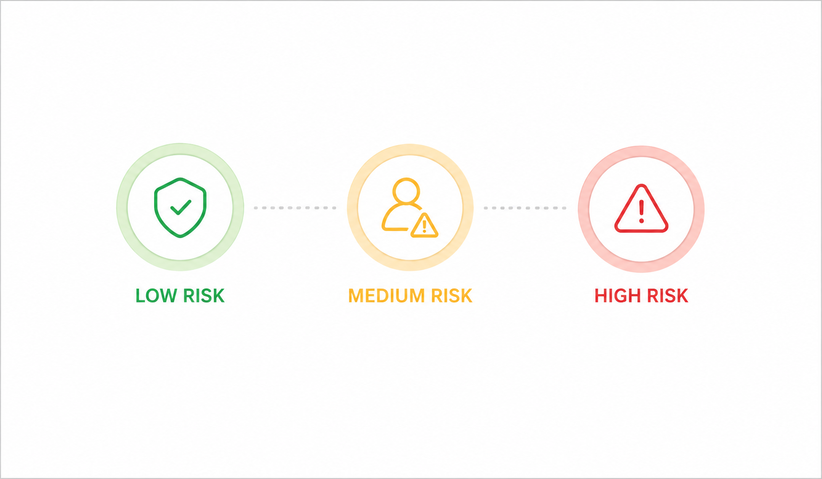
Most AML frameworks organize customers into three risk tiers. Each tier carries different compliance obligations and determines how much scrutiny a customer receives throughout the relationship.
Low-Risk Customers
Low-risk customers typically have transparent, verifiable profiles and predictable transaction behavior. A salaried employee with a domestic bank account, a small local business with straightforward operations, or a long-established company in a low-risk industry would generally fall into this category.
These customers require standard CDD at onboarding and periodic reviews on a longer cycle, often every two to three years. Regulators still expect businesses to monitor this group, but the intensity is proportionately lower.
Medium-Risk Customers
Medium-risk customers present some elevated risk factors but not enough to trigger full enhanced due diligence. A business operating in multiple jurisdictions, a customer with a more complex ownership structure, or an individual with limited transaction history might sit in this tier.
Medium-risk customers require closer monitoring than low-risk ones and more frequent periodic reviews, typically every one to two years. Any change in their behavior or circumstances can move them into the high-risk tier.
High-Risk Customers
High-risk customers require enhanced due diligence and the highest level of ongoing scrutiny. Common examples include PEPs, customers connected to high-risk jurisdictions, businesses in cash-intensive industries, and any customer where the source of funds is unclear or difficult to verify.
Onboarding a high-risk customer typically requires senior management approval, and their profiles need review at least once a year. Some businesses choose to decline certain high-risk customers entirely if the compliance cost outweighs the business benefit.
Common Challenges and Best Practices for Customer Risk Assessment
Even businesses with strong compliance programs run into practical difficulties when managing customer risk assessments at scale.
Maintaining Consistent Risk Scoring
Inconsistent scoring is one of the most common weaknesses regulators flag during AML audits. The root cause is usually an over-reliance on manual judgment, where different analysts apply the same criteria differently and two customers with identical profiles end up with different risk ratings. Businesses can address this by:
- Building standardized scoring models with clearly defined criteria and numeric thresholds for each risk factor
- Documenting the rationale behind every risk rating decision to create a defensible audit trail
- Running regular calibration sessions where the compliance team reviews recent decisions together and realigns on edge cases
Keeping Customer Data Up to Date
A risk assessment is only as good as the data behind it. Customer circumstances change: people take on new public roles, businesses enter new markets, and ownership structures shift. Many businesses struggle to capture these changes in a timely way, particularly when they rely on customers to self-report updates.
Best practice is to combine periodic reviews with event-driven triggers, so that any significant change in a customer’s profile prompts an immediate reassessment rather than waiting for the next scheduled review cycle.
Balancing Compliance and Customer Experience
Thorough risk assessment takes time, and customers notice. Lengthy onboarding processes, repeated requests for documentation, and frequent review check-ins can frustrate customers and drive them toward competitors.
The challenge is to apply the right level of scrutiny without creating unnecessary friction for low-risk customers. Many businesses address this by streamlining data collection for straightforward cases while reserving detailed manual review for customers who genuinely warrant it.
Automating AML Customer Risk Assessments
Manual risk assessment does not scale well. As a customer base grows, reviewing each profile individually becomes unsustainable in both time and cost. Automation helps by:
- Applying consistent scoring rules across large customer volumes simultaneously
- Flagging anomalies in transaction behavior in real time rather than waiting for scheduled reviews
- Generating audit trails automatically to satisfy regulatory documentation requirements
While AML customer risk assessment focuses on regulatory compliance, online merchants also face identity fraud, bot traffic, VPN abuse, and account takeover attempts before transactions even occur.
Combining AML controls with fraud prevention tools helps businesses reduce operational risk without adding unnecessary friction for legitimate customers. For Shopify merchants, solutions like Blockify Fraud Filter can automatically detect and block high-risk visitors, VPNs, proxies, bots, and suspicious IP addresses before fraudulent activity escalates.
FAQs About AML Customer Risk Assessment
What is the difference between customer risk assessment and KYC?
KYC (Know Your Customer) is the process of verifying a customer’s identity. Customer risk assessment uses that information to evaluate how much money laundering risk the customer actually presents.
How often should customer risk assessments be updated?
High-risk customers should be reviewed at least once a year. Medium-risk customers typically require review every one to two years, and low-risk customers every two to three years.
What makes a customer high risk in AML?
Common high-risk indicators include PEP status, connections to high-risk jurisdictions, involvement in cash-intensive industries, complex or opaque ownership structures, and inability to clearly verify source of funds.
Can customer risk assessments be automated?
Yes. Automation can apply consistent scoring rules at scale, monitor transactions in real time, and generate audit trails automatically. However, automation is only as effective as the risk model behind it.
Conclusion
Customer risk assessment is not a box-ticking exercise. It is the mechanism that tells a business where its real AML exposure lies and how to allocate compliance resources accordingly.
A well-structured process covers the right risk factors, assigns ratings consistently, applies proportionate due diligence, and keeps customer profiles current over time.
