
Click Fraud Explained: Why Your Ads Get Clicks but No Sales

Ads spend climbs every week. The click-through rate looks healthy on paper. Conversions, however, stay flat. Most marketers blame targeting, ad copy, or landing pages. They optimize endlessly, yet the numbers refuse to move.
There is another explanation. Someone or something clicks your ads with zero intention of buying. That is click fraud.
Click Fraud Definition: What It Really Means
Click fraud refers to fake or invalid clicks made without genuine user intent. While it is commonly linked to paid ads, it can also target affiliate links, CTA buttons, hyperlinks, and other clickable elements on websites or apps to manipulate traffic and revenue.
For example, fraudulent clicks may be generated to:
- Draining a competitor’s ad budget
- Inflating publisher or affiliate earnings
- Triggering fake conversions or actions
- Distorting website traffic and campaign performance data
These fake clicks may come from bots, click farms, malware-infected devices, or real users paid to generate fraudulent traffic.
Is Click Fraud Illegal?
In many jurisdictions, click fraud qualifies as a form of computer fraud or false advertising. Prosecutors have pursued cases against large-scale fraud operations before, and some have resulted in criminal charges.
In practice, however, enforcement remains rare. Proving intent is difficult. Tracing fraudulent clicks back to a specific individual or organization requires technical evidence that most advertisers cannot obtain on their own. Most cases never reach a courtroom.
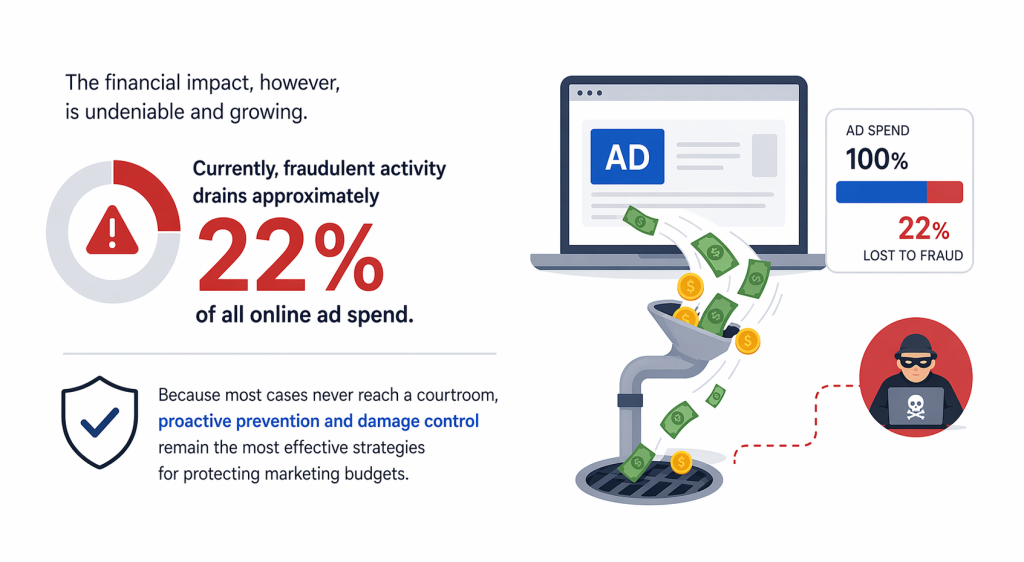
The financial impact, however, is undeniable and growing. Currently, fraudulent activity drains approximately 22% of all online ad spend. Because most cases never reach a courtroom, proactive prevention and damage control remain the most effective strategies for protecting marketing budgets.
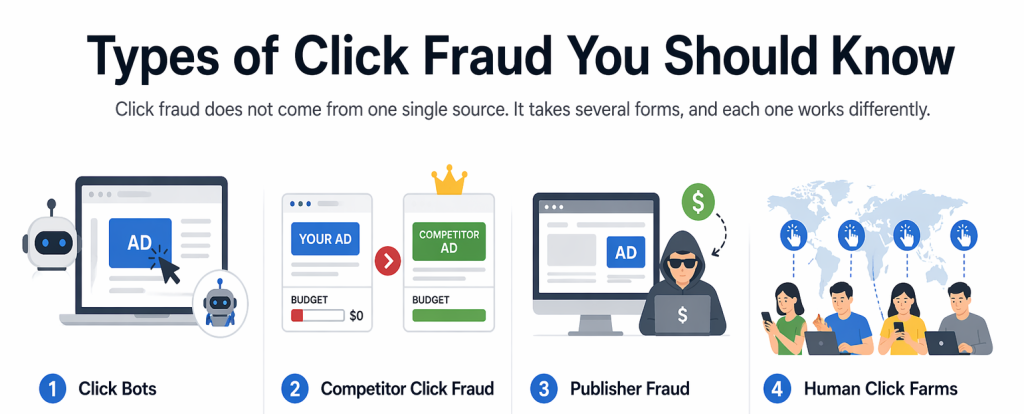
Types of Click Fraud You Should Know
Click fraud does not come from one single source. It takes several forms, and each one works differently.
Click Bots
Click bots are automated scripts that generate fake clicks on ads at scale. A single bot network can fire thousands of clicks within minutes. They mimic real user behavior well enough to bypass basic filters, which makes them difficult to detect without proper tracking tools.
Competitor Click Fraud
Competitors click your ads repeatedly to drain your daily budget. Once the budget runs out, your ads stop showing. Their ads take the top spot. This tactic appears most often in local business markets, where a handful of competitors fight for the same audience.
Publisher Fraud
Some website owners click the ads displayed on their own pages to inflate ad revenue. The advertiser pays for each click. The publisher collects the payout. No real user ever sees the product.
Human Click Farms
Click farms use real people to click ads manually. Because actual humans perform the clicks, behavior patterns look more natural than bot traffic. Traditional detection tools struggle to flag them, which makes this form of fraud harder to catch than automated scripts.
The Subject of Click Fraud: Who Is Actually Behind It?
Click fraud does not happen randomly. Specific actors carry it out with clear financial or competitive motivations.
The motivation in every case comes down to money or market position.
| Method | Motivation |
|---|---|
| Automated scripts generate fake clicks at scale across thousands of campaigns | Sell fraudulent traffic or offer competitor sabotage as a service |
| Manually or automatically click rival ads in high-CPC industries | Drain daily budget so their own ads take the top position |
| Click ads displayed on their own inventory | Inflate payout from ad networks |
How Click Fraud Affects Your Ads
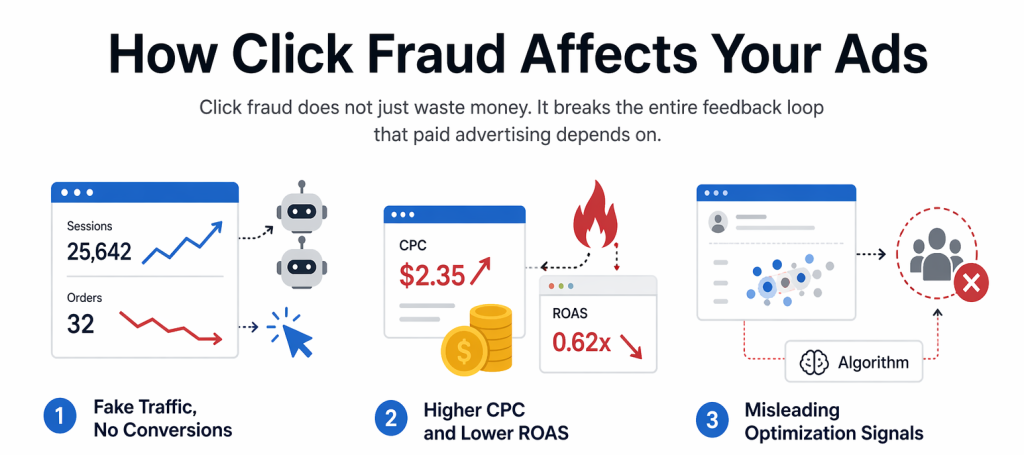
Click fraud does not just waste money. It breaks the entire feedback loop that paid advertising depends on.
Fake Traffic, No Conversions
Bots and fraudulent clicks inflate traffic numbers without producing any real demand. Sessions increase. Orders do not follow. The gap between traffic volume and conversion rate widens, and the campaign appears to underperform for no clear reason.
Higher CPC and Lower ROAS
Every fake click consumes a real budget. As spend drains faster, cost-per-click rises while return on ad spend falls. Advertisers often respond by increasing budgets, which only gives fraudsters more to burn through.
Many advertisers, especially in high-competition industries like Finance, Real Estate, Gaming, or iGaming, experience even higher rates. Lunio’s 2026 Global Invalid Traffic Report (analyzing 2.7 billion clicks) found average invalid traffic rates reaching 10–18% in sectors such as Finance (10.12%), Real Estate (13.61%), and Gaming (18.49%).
Misleading Optimization Signals
Ad platforms and tracking pixels learn from click data. Fraudulent clicks feed the algorithm wrong signals. The system optimizes toward audiences that never convert, and campaign performance deteriorates over time without any obvious cause.
Signs You May Be Facing Click Fraud
These patterns in your analytics deserve immediate attention:
- Unusually high CTR with no matching increase in conversions
- High bounce rate across paid traffic, well above organic benchmarks
- Near-zero session duration from users who click but leave instantly
- Suspicious geographic data, such as traffic spikes from regions outside your target market
No single signal confirms click fraud on its own. When several appear together, however, the pattern is hard to ignore.
Click Fraud Prevention: What You Can Do
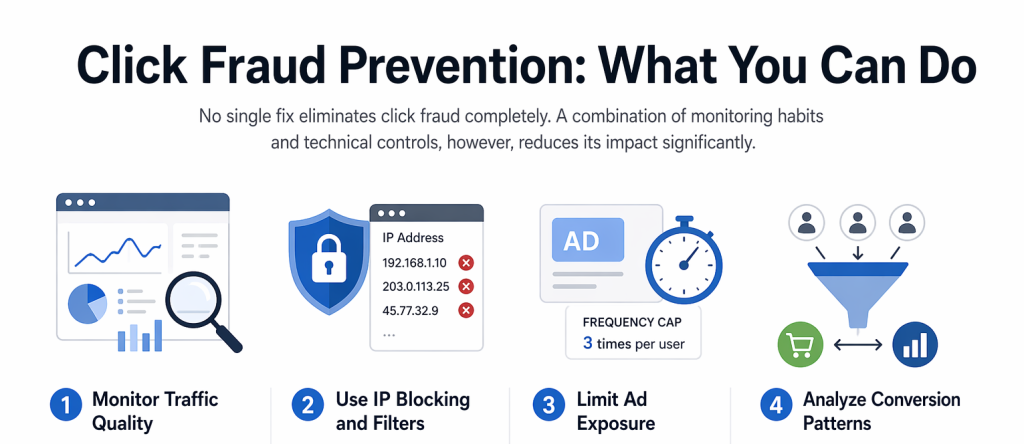
No single fix eliminates click fraud completely. A combination of monitoring habits and technical controls, however, reduces its impact significantly.
Monitor Traffic Quality
Review analytics regularly, not just top-line metrics. Look at bounce rate, session duration, and pages per visit segmented by campaign. Sudden shifts in these numbers often signal fraudulent traffic before the budget damage becomes serious.
Use IP Blocking and Filters
Most ad platforms allow advertisers to exclude specific IP addresses. When analytics reveal suspicious sources, block them directly. Build an exclusion list over time and update it as new patterns emerge.
Limit Ad Exposure
Frequency caps control how many times one user sees the same ad. Setting a reasonable limit cuts off the repeat-click behavior that bots and manual fraud rely on to drain budgets quickly.
Analyze Conversion Patterns
Compare click volume against actual purchases at regular intervals. A healthy campaign shows a consistent relationship between the two. A growing gap between clicks and conversions points to traffic that was never real to begin with.
Blockify: Click Fraud Protection Built for Real Campaigns
Most advertisers only notice fraudulent traffic after the damage is done. Platform reports often arrive too late, and by then, wasted ad spend has already added up.
Blockify Fraud Filter & Blocker helps businesses stop suspicious traffic before it turns into costly clicks. Whether you run campaigns for a Shopify store or a Wix site, the tool monitors incoming traffic in real time and blocks fraudulent sources early.
- Bot and proxy detection across all incoming traffic
- Real-time IP blocking before fraudulent sources consume budget
- Country and VPN filtering to remove high-risk traffic at the source
- Data filtering to preserve clean signals for campaign optimization
🛡️ Secure Your Store with Blockify
Prevent fraud and protect your store from entry to checkout.
Invalid clicks distort the data that ad platforms use to optimize delivery. Removing them early keeps the algorithm learning from real buyers, which translates directly into stronger return on ad spend over time.
FAQs About Click Fraud
Click fraud can be difficult to detect, and many advertisers still have questions even after understanding the basics. Here are some common questions businesses ask before investing in prevention tools.
Can Google Ads detect click fraud automatically?
Google Ads automatically filters some invalid clicks and may issue refunds for obvious fraudulent activity. However, advanced bots, VPN traffic, and human click farms can still bypass platform detection.
Which industries experience the highest click fraud rates?
High-CPC industries usually face more fraud because each click is worth more money. Common examples include finance, insurance, legal services, real estate, gaming, SaaS, and ecommerce.
Can click fraud hurt SEO performance?
Click fraud does not directly affect rankings on Google. However, fake traffic can skew engagement metrics and lead businesses to make poor SEO or advertising decisions.
How can I tell if my ads are being targeted by click fraud?
Common warning signs include unusually high click-through rates, low conversions, high bounce rates, short session durations, and traffic from locations outside your target market.
Are click fraud protection tools worth the investment?
For businesses running larger ad budgets or operating in competitive industries, protection tools can help reduce wasted spend and keep campaign data cleaner for better optimization.
Conclusion
Click fraud is not a new problem, and it will not disappear. As long as paid advertising exists, bad actors will find ways to exploit it. The goal is not to eliminate fraud entirely. The goal is to limit its impact on budget and data quality.
Monitor traffic patterns consistently. Invest in tracking infrastructure that goes beyond basic platform reports. Use a protection tool when campaign scale makes manual monitoring impractical.
The advertisers who perform best in paid channels are not the ones who spend the most. They are the ones who spend on the right clicks.
>>> Read More: Top 11 eCommerce Fraud Types & Smartest Things Online Retailers Can Do
