
How to use a free gift to improve your Shopify conversion rate

Adding a discount is the initial thought when conversion declines, isn’t it? Yet, the majority of the shoppers do not go away due to the high price. They walk out since the bargain is not worth it. It is a perceived value issue, and discounts cannot resolve it. They simply chew up your margin.
Free gifts work differently. Placed at the right point in the buying journey, a gift shifts how shoppers evaluate the deal without you lowering a single price. This guide breaks down the 3 biggest conversion barriers on Shopify, maps each one to a specific free gift tactic, and shows you how to pick the right gift, set it up, and measure whether it’s actually working.
Let’s check them out!
What stops visitors from converting on Shopify?
Most Shopify visitors do not leave for the same reason. The friction changes as they move from the product page to the cart and then to checkout. In practice, 3 conversion barriers are most common:
- Hesitation barrier: On the product page, shoppers are still deciding whether the item feels worth the price. They may like the product, but they are not fully convinced yet. This usually sounds like, “I’m not sure this is worth it.”
- Momentum barrier: In the cart, the problem is often a delay rather than rejection. The shopper has shown intent by adding items, but they are not ready to finish the purchase right away. This is where “I’ll buy later” starts to hurt conversion.
- Value barrier: Extra checkout costs can weaken the offer. Shipping fees are a common trigger because they change how the final deal feels, even when the fee itself is not very high. The shopper may still want the product, but the order no longer feels like a clear win.
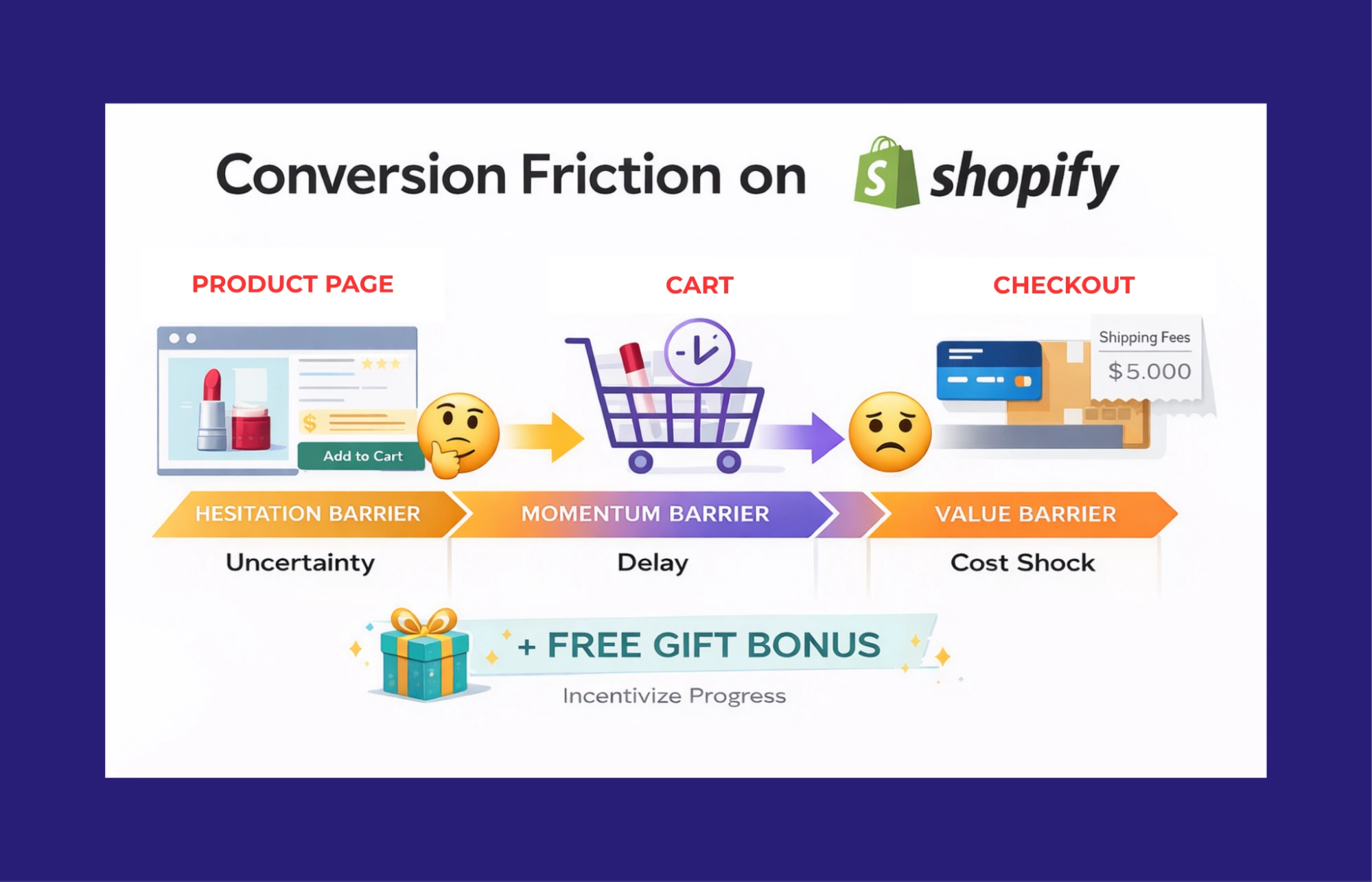
A free gift can help because it adds value at the exact moment hesitation arises. It does not lower the product price. Instead, it gives shoppers a stronger reason to move forward. In the next sections, we’ll match each barrier with a specific free gift tactic that fits that stage of the journey.
How to break the 3 biggest conversion barriers using free gifts
Phase 1: Breaking hesitation (the product page)
The mindset behind the drop-off
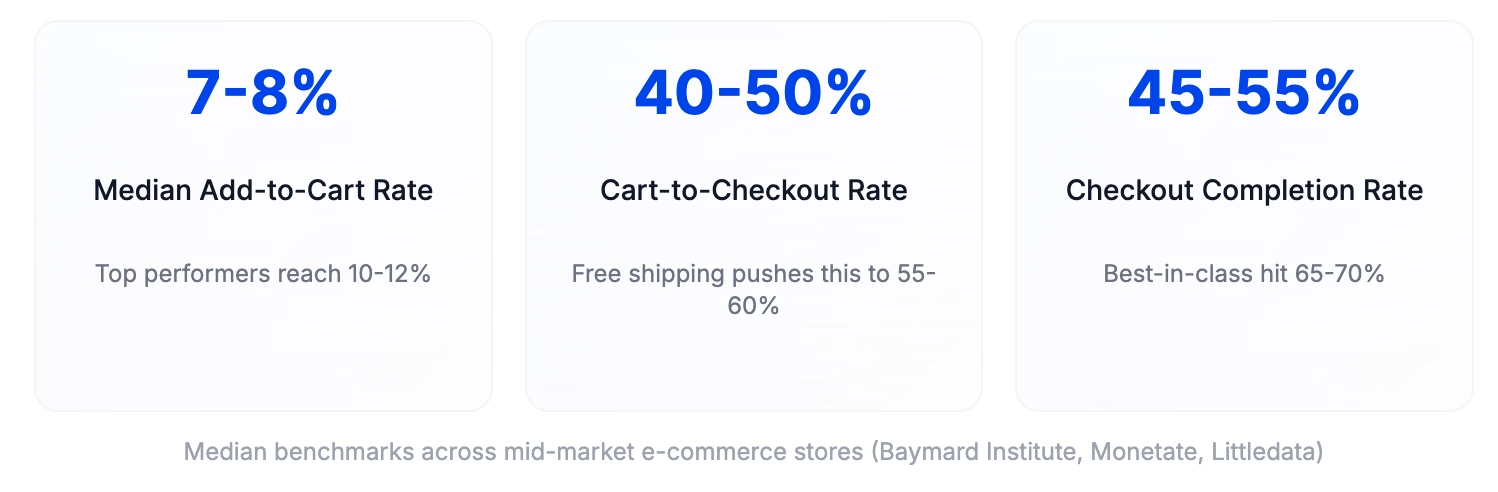
When a shopper visits the page of a particular product, they are doing a basic yet crucial calculation: “What will I get in exchange after spending this amount?” It is here where the majority of ecommerce funnels fail. KISSmetrics indicates that only approximately 7-8% of visitors make it to the add-to-cart stage, which implies that more than 90% of visitors to the product page are not willing to go further. The most obvious guess is that it’s price sensitivity, but that is hardly the problem.
What’s actually happening is a failure to clearly communicate value.
Google’s “Decoding Decisions” research sheds light on this behavior. It shows that shoppers operate in what Google calls the “messy middle” – a loop between:
- exploring options
- evaluating whether something is worth it
In this loop, users don’t simply look for the cheapest option. In fact, global search trends show that interest in “best” consistently outpaces “cheap.”
In other words, shoppers are not trying to spend less. They’re trying to justify the spend.
The tactic: surface the gift before the “Add to Cart” button
Place a clear, benefit-driven message near the Add to Cart button that highlights the free gift. For example:
- “Add to cart and receive a free travel-size serum”
- “Free sample included with this product”
This message needs to be visually noticeable and instantly understandable.
Just as important is placement. The free gift callout should appear right next to the decision point, typically above or below the Add to Cart button. This is where shoppers pause and make their final evaluation, so surfacing the extra value at this exact moment helps tip the decision in your favor.
Real brand example
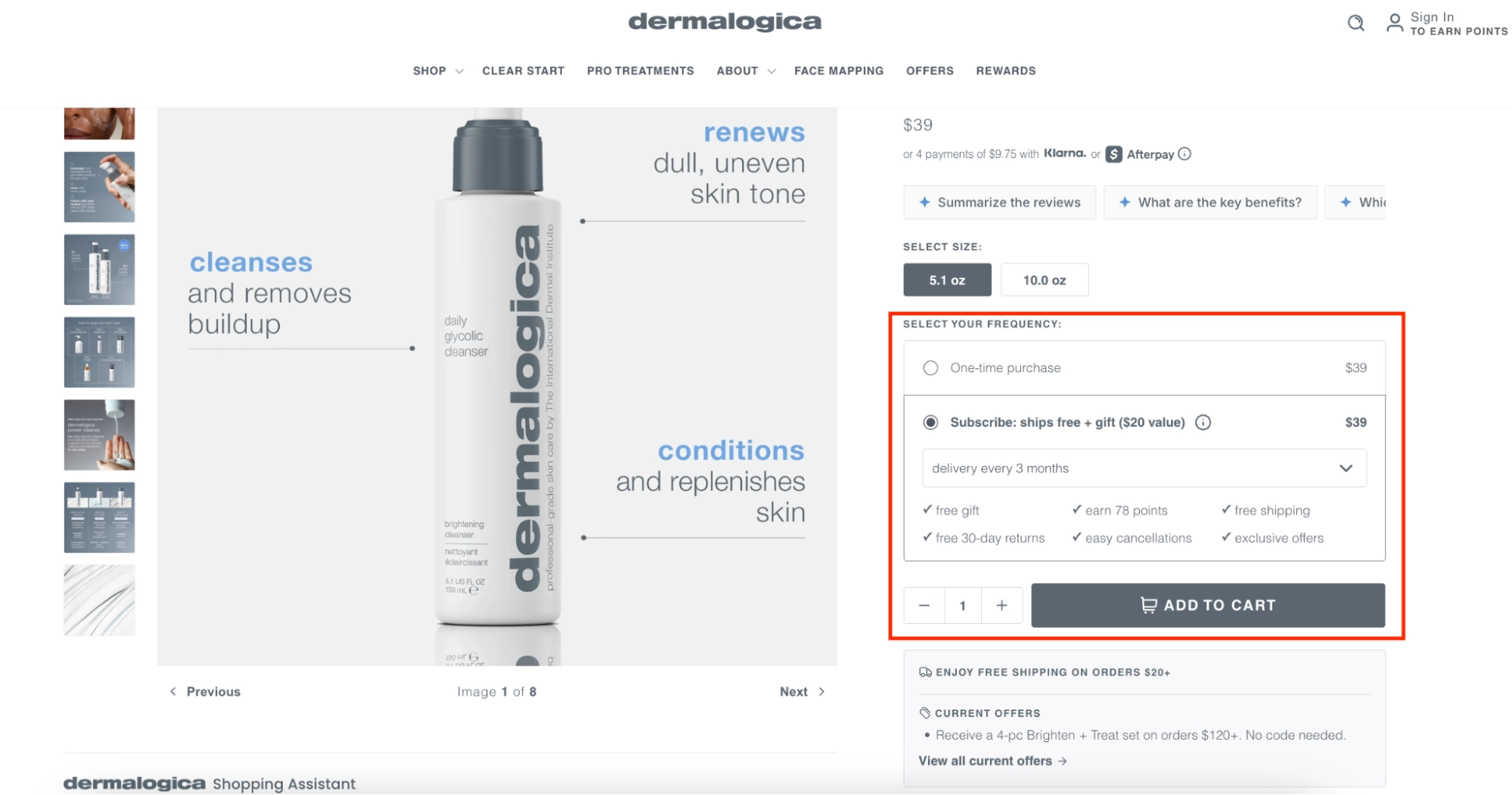
Dermalogica directly incorporates free gifts as a part of the product page, which is associated with a subscription. The purchase selection box presents a clear value proposition, that is “free gift ($20 value)”, to the shopper, right above the “Add to Cart” button. This positioning allows the value added to be seen at the point of choice, helps minimize hesitation, and prompts users to a more valuable choice.
Phase 2: Breaking lost momentum (the cart)
The mindset behind the drop-off
Getting someone to add an item to the cart is a win, but it doesn’t mean they’re committed. Baymard Institute’s aggregate of 50 studies puts the average cart abandonment rate at 70.22%. And a large share of those abandoners aren’t saying “no.” Baymard’s own research found that 43% of US online shoppers who abandoned a cart in the past quarter said the reason was simply “I was just browsing/not ready to buy.”
The problem is not rejection in most instances. It’s just that the cart stage has lost its momentum, and then they will forget their intention to proceed to check out of the shop.
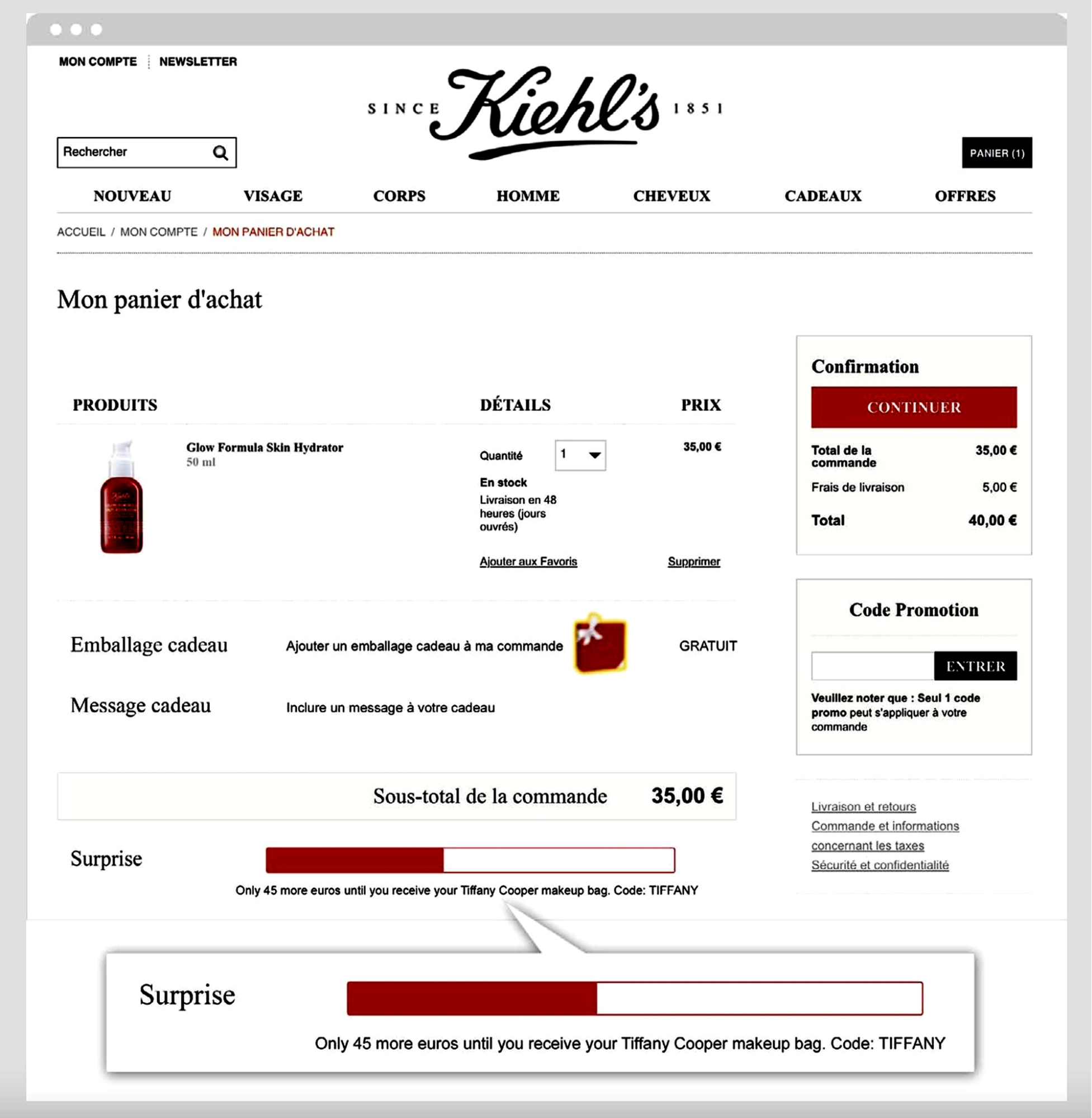
Tactic 1: Progress bar with a spend threshold
For example: “You’re $12 away from a free gift!” As the cart value increases, the bar fills, giving them a visible goal to pursue.
A well-documented example comes from Kiehl’s, featured in an AB Tasty case study. The skincare brand added a visual progress gauge on its cart page that shows how much more a shopper needs to spend to unlock a free Tiffany & Co. makeup bag. The results included a 31% increase in total revenue, a 5% increase in average basket size, and 7% more clicks on the “Continue” CTA.
Tactic 2: Auto-add the gift to the cart
This is an appeal to endowment, in the eyes of psychologists. When an item has become something that is in your possession, even just physically in a shopping cart, then you appreciate it more and lose it. Research on loss aversion and the endowment effect indicated that it is much more motivating to make a message sound as if the customer already possesses the benefit (e.g. Your free gift has been added) than as a benefit that they may receive.
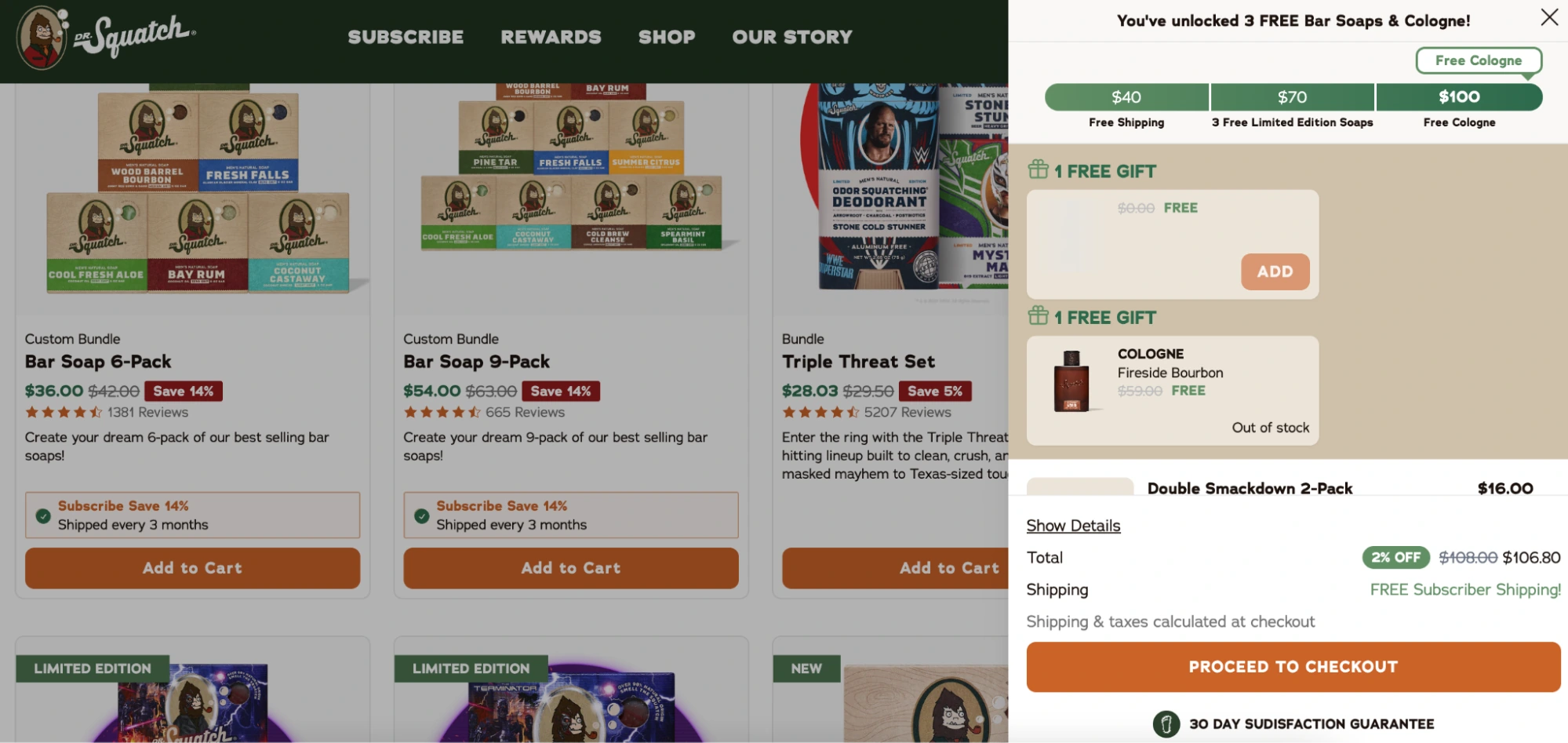
Dr. Squatch, the men’s grooming brand, uses this approach with tiered free gift unlocks in its cart. Shoppers who meet a spending threshold see a free soap or grooming item auto-added. The gift appears automatically, and if the shopper removes products and drops below the threshold, it disappears, creating that small feeling of loss that nudges them to keep the cart value up.
Phase 3: Breaking the value drop (the checkout)
The mindset behind the drop-off
A customer who has been to the checkout is often already determined to buy the product, yet additional expenses may always ruin the whole transaction at the nick of the time. According to the 2025 data provided by Baymard Institute, 39% of cart abandoners reported additional charges, including shipping, taxes, or fees, as the cause.
In many cases, the fee itself is not the full problem, because once the total moves from $65 to $70, the order can simply feel less worth it than it did a few seconds earlier.
The tactic: show a gift confirmation at checkout
Show a prominent reminder on the checkout or order summary that the free gift has been provided, e.g., Your free [Gift Name] is included in this order or a visible line entry that indicates that the gift is free at $0.00.
To ensure the free gift in the order summary can be effectively added as a special dedicated line item in the order summary so that the gift can be considered part of the order, not an abstract promotion. A brief congratulatory message or a visual emphasizer (when the gift is verified at the cash desk) is also added to some of the stores.
Real brand example
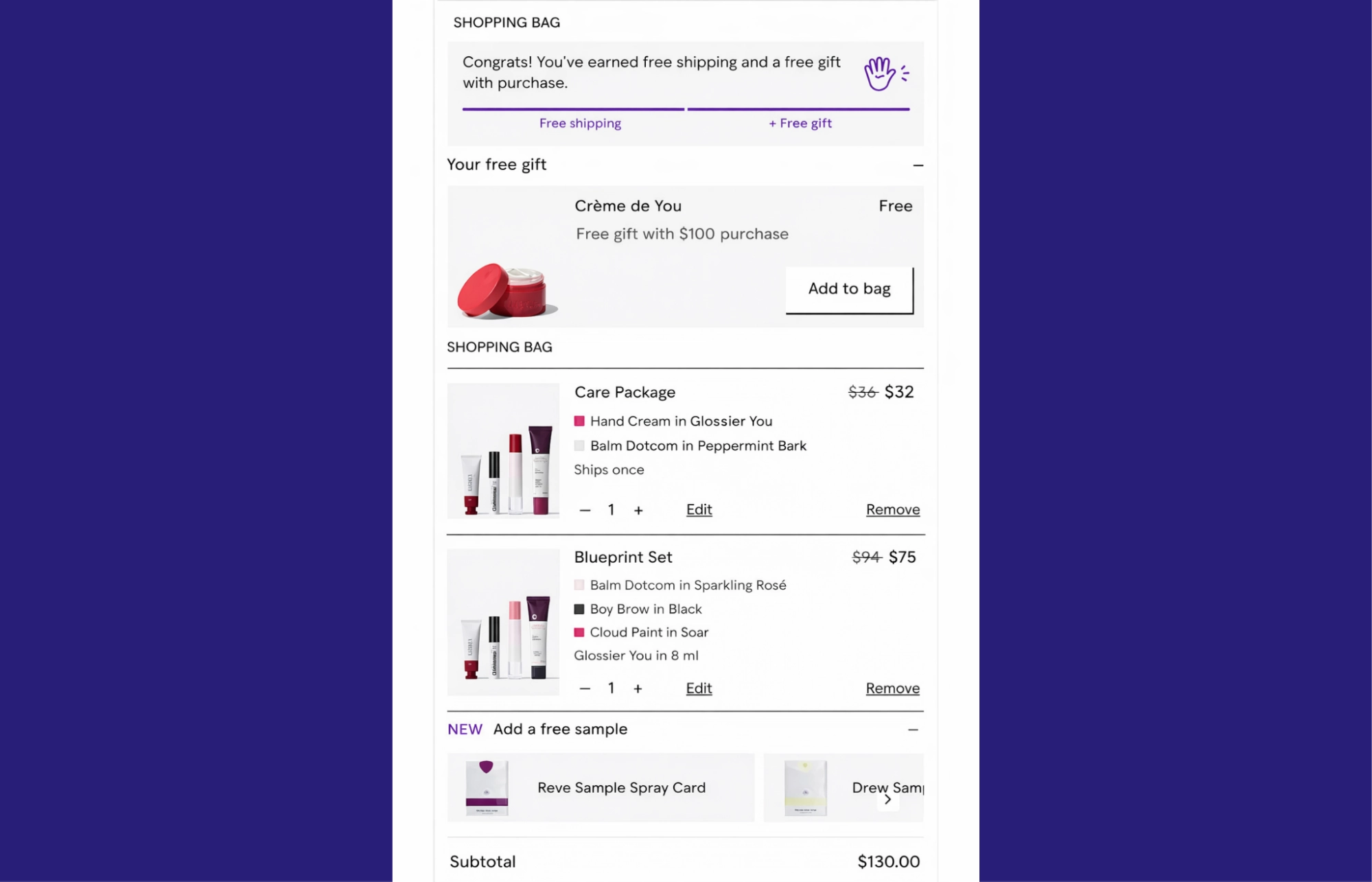
Glossier periodically offers promotions, during which the buyer receives a full-size item once they exceed a buying limit (such as a free Crème de You body cream with a purchase of $100+). The gift is obviously brought to the fore in the cart as a special line entry, and this adds value before checkout and makes sure the gift is included in the overall consideration by the shopper.
Which free gifts drive the best conversion rates?
Below are 4 gift types with the strongest track records.
Mini versions of your best-selling product
When a customer doubts about a $58 serum, a free mini will allow them to test it without cost. Sephora does this at scale: two free samples with every online order, ~40 options to choose from. About 23% of recipients end up buying the full-size product within 60 days. U Beauty also saw 40% of sample recipients convert to full-size through their sampling program.
How to run this on Shopify:
- Select your best seller/s 1-2 and develop sample-size SKUs.
- Automatically add the gift to the cart when a customer meets a threshold in the cart (e.g., 50+).
- Include a callout by your “Add to Cart” button: Free mini [product name] with purchases of $50+.
- After delivery, send a follow-up email with a direct link to buy the full size
Best for: Skincare, cosmetics, supplements, food, and beverages.
Accessories that improve the main product experience
An accessory gift can provide immediate value to what customers already have in their cart, instead of having the option to try before they buy. For example: protein powder in a shaker cup, skincare in a travel pouch, or a cleaning cloth with sunglasses. The primary purchase seems more complete as soon as it comes.
How to run this on Shopify:
- Select an item that your customer would use with the primary item (not just anything)
- Minimize expenses: branded pouches, applicators, or small tools typically cost 1-3 units at volume.
- Present the gift on the product page, not merely in a banner on the rest of the site. Before the customers can add to the cart, they must see the value.
- Incorporate product photography that involves the accessory beside the primary product, thus making the combination seem purposeful.
Best for: Fitness/supplements, electronics, beauty, kitchen products, outdoor gear.
Consumable gifts
A consumable gift gets used up, which creates a natural reason for the customer to come back. According to Mobiloud’s 2026 benchmarks, repeat rates by category tell the story:
- Grocery and food brands see repeat purchase rates above 40%.
- Pet supplies hit 30–40%.
- Skincare and supplements sit around 25–29%.
Therefore, the more consumable your present, the better chances of getting repeat customers.
How to run this on Shopify:
- Give a sample of another product or flavor that has not been tried yet by the customer.
- In the case of subscription stores: alternating the free consumables every month to ensure that customers get to know new SKUs.
- Include a card in the package: Liked this sample? Get it in full size here” with a QR that links to that product page.
- Monitor which free samples lead to the highest number of full-size purchases, and invest in these.
Best for: Food and beverage, supplements, skincare, pet supplies, and cleaning.
Exclusive gifts not sold separately
While the other three types reduce risk or add utility, exclusive gifts create urgency. When a customer knows the gift is only available for a limited time or limited quantity, the pressure to act now pushes them past hesitation.
How to run this on Shopify:
- Create a gift that’s not available for purchase anywhere else. This is what makes it “exclusive”
- Set a clear end date or quantity limit and display it prominently: “Free [gift name] with $75+ orders. Only 500 available.”
- Use a progress bar in the cart to show how close the customer is to unlocking the gift
- Design the gift to be photo-worthy. If customers post unboxing content, you get free organic reach
Best for: Fashion, beauty, lifestyle, DTC brands with strong visual identity, seasonal campaigns.
Top 3 Shopify apps for running free gift campaigns
The 3 best-rated ones below are compared in terms of offer type, method of gift delivery, cart drawer support, checkout support, and ease of setup.
BOGOS: Free Gift Bundle Upsell
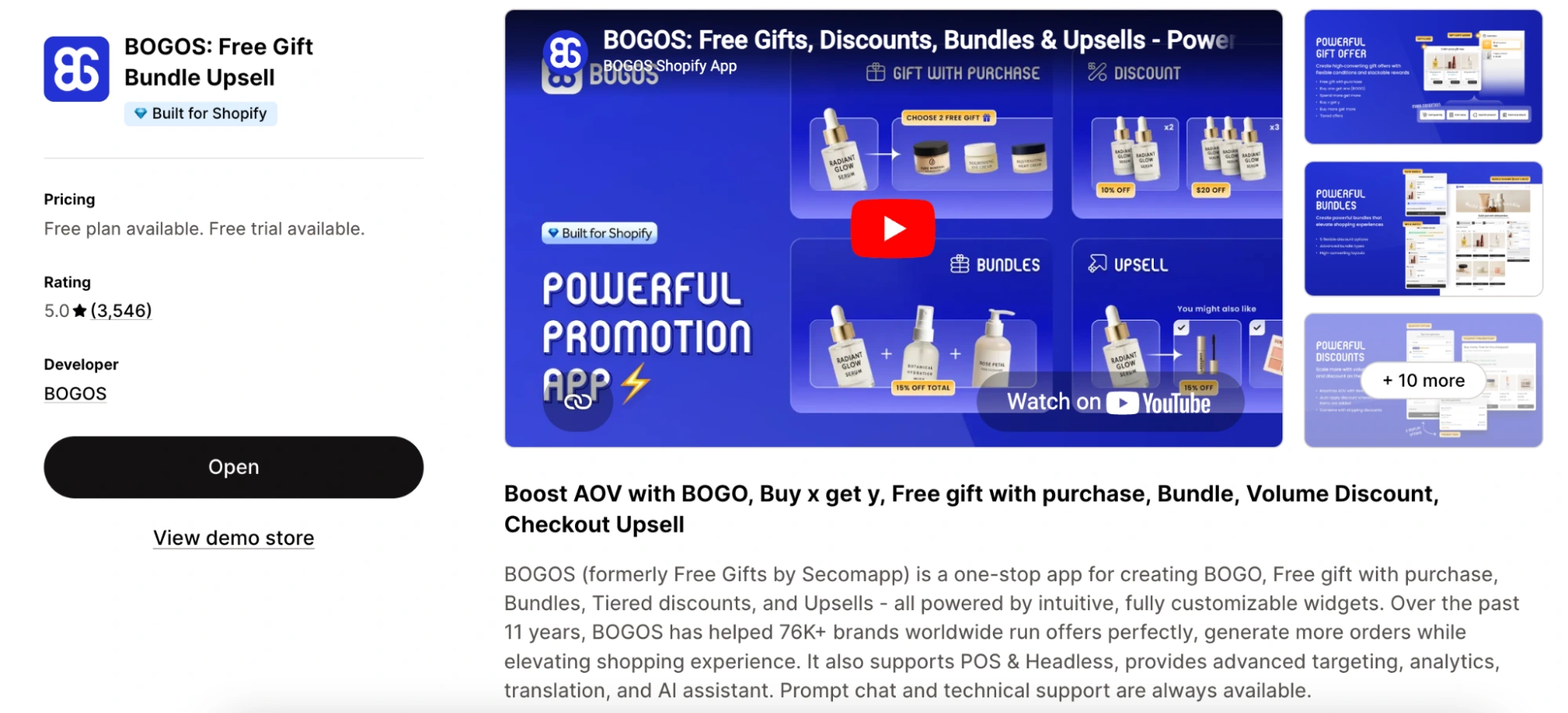
Rating (as of April 2026): 5.0 (3,500+ reviews) | Pricing: Free plan available, paid from $29.99/mo
BOGOS is the most reliable free gifts, bundles, upsells, and discounts Shopify app, with 11 years of experience, 81K active users, and a 5.0 average rating based on 3,500+ reviews. It is relied upon by 5,100+ Shopify Plus stores.
For free gift campaigns, it can deal with straightforward offers like “spend $50, get a free item” to complex tiered rewards and customer-specific targeting. You can auto-add gifts to the cart or let customers pick their own through a sleek pop-up. The most striking thing about it is the extent of control: target by purchase history, location, or sales channel, and keep your offers front-and-center with progress bars, gift thumbnails, and dedicated offer pages that accompany the shopper on the way.
Beyond free gifts, BOGOS packs in product bundles, mix-and-match deals, volume discounts, and checkout upsells – all manageable from one dashboard.
What it offers:
- Flexible conditions, including tiered gift offers: Set up essential conditions (cart value, quantity, products, collections, combos) and create multi-tier rewards with min/max thresholds per tier.
- Auto add gift to cart & gift pop-up: Gifts can be automatically added or let customers choose via a customizable Gift Slider.
- Advanced targeting: Target by URL, order history, customer tags, geo-location, and sales channels for precise campaign control.
- Promotion widgets: Drive visibility with progress bars, Today’s Offer block, gift icons, gift thumbnails, and dedicated offer pages.
- Multi-channel support: Run offers smoothly across Shopify POS, mobile apps, and headless storefronts via the Hydrogen API.
- Beyond Gift With Purchase, BOGOS supports other promotion types such as bundles, upsells, volume discounts, cart discounts, and discounts on the cheapest or most expensive items
Worth noting: BOGOS has been around for 11+ years and supports Shopify Flow integration, allowing you to trigger gift campaigns based on customer tags, order history, or other automated workflows. The free plan allows 30 lifetime orders, so you can test it with real customers before committing.
EG Auto Add to Cart Free Gift
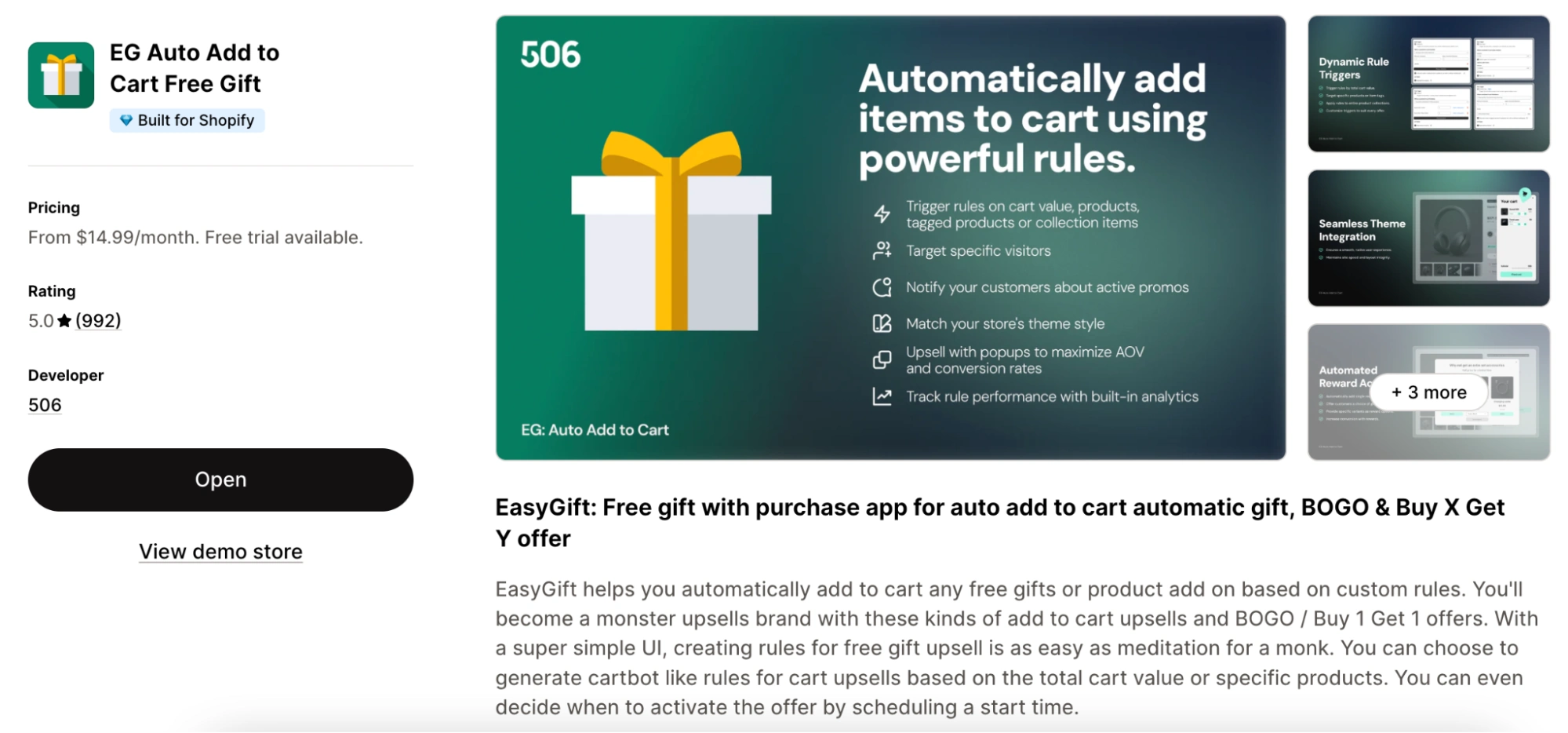
Rating (as of April 2026): 5.0 (990+ reviews) | Pricing: From $14.99/mo (no free plan, 5-day trial)
EG Auto Add (also called EasyGift) is a more specialized application. It does one thing exceptionally well: automatically adds gifts or promotional products to the cart depending on the rules that you set. Assuming you need your customer to hit a threshold for the gift to appear in the cart, this will work with only a few setups.
What it offers:
- Offer types: BOGO, Buy X Get Y, free gift with purchase, cart-value-based gifts, collection-based rules
- Gift delivery: Auto-add to cart based on cart total, specific products, or collections. Supports scheduling so you can set offers to start and end automatically.
- Cart drawer: Works with Cartix and Monster Cart. For other cart drawer apps or custom drawers, manual integration may be required, depending on your theme.
- Checkout: Compatible with Shopify checkout. Uses Shopify Functions for cart and checkout validation.
- Setup: The UI is simple. Standard plan ($14.99/mo) supports up to 3 rules with basic triggering. The Unlimited plan ($29.99/mo) removes the rule cap and adds geotargeting, product page redirects, and priority feature requests.
Worth noting: EG does not have bundles, volume discounts, or checkout upsells. It is a gift/auto-add tool, in particular. The cheaper price and the less complex interface could be sufficient should that be the only criterion. The Unlimited plan geotargeting can be applied to stores with region-based promotions.
Gift Box
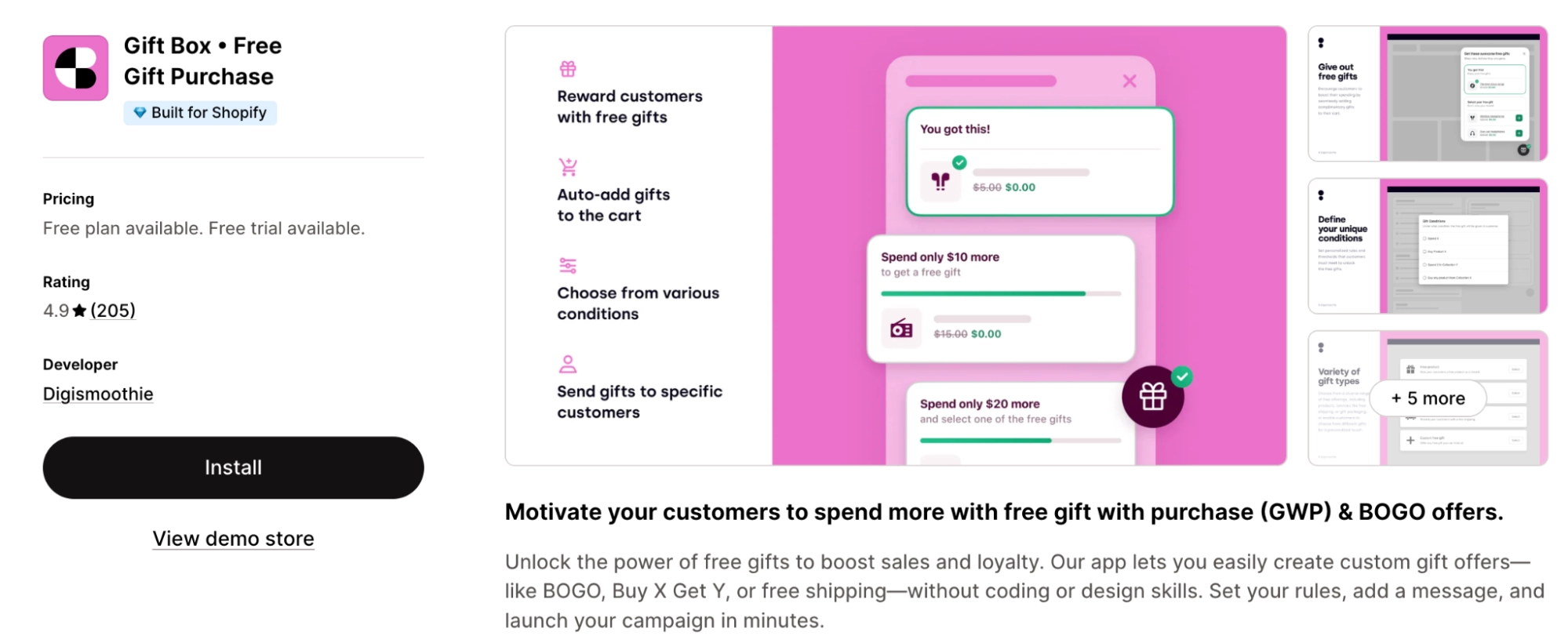
Rating (as of April 2026): 4.9 (200+ reviews) | Pricing: From $29.99/mo (free for dev stores, 3-day trial)
Gift Box by Digismoothie is a clean, straightforward app focused on free gift promotions. It supports four offer types and emphasizes ease of setup.
What it offers:
- Offer types: BOGO, Buy X Get Y, spend-based gifts, collection-based gifts. Also includes a free shipping threshold option.
- Gift delivery: Auto-add to cart (can be toggled on/off). Customers can also reject gifts by removing them from the cart.
- Cart drawer: Has improved drawer cart support (updated in late 2022). Works with Candy Rack integration.
- Checkout: Compatible with Shopify checkout and discount codes. Multi-currency support depends on the checkout method you use (full support with the standard method, limited with the discount-code-only method).
- Setup: Designed to launch gift offers in minutes. Multi-language support via Shopify’s Translate & Adapt app. Custom CSS available. The interface is minimal, which makes it fast to configure but also means fewer customization options compared to BOGOS.
Worth noting: Gift Box products are priced based on the volume of the order and not features. All plans get the same features, but the monthly cost increases as your order count grows ($29.99 for 0–100 orders, $49.99 for 101–500, $79.99 for 501–1,000). This can be costly with the volume of stores. The 60-day money-back guarantee provides you with an extra 60 days to test it out compared to the 3-day trial.
👉 How to choose:
- Pick BOGOS if you want a single app that handles gifts, bundles, volume discounts, and upsells together. It’s also the best fit if you run a Shopify Plus store (checkout upsell, headless API), use POS, or need Shopify Flow automation.
- Pick EG Auto Add if your needs are simple (auto-add gifts based on cart rules) and you want the lowest price entry point. Good for smaller stores that don’t need bundles or upsells.
- Pick Gift Box if you want a fast setup with minimal configuration. The order-based pricing works well for lower-volume stores but becomes less competitive as you scale past a few hundred orders per month.
👉 For more gift with purchase app reviews, read this detailed guide: 8 Best Shopify Gift With Purchase Apps To Try in 2026
Conclusion
So here’s where we land. Discounts train customers to wait for the next sale. Free gifts train them to buy now. That’s the core difference, and it’s why we put this guide together. We’re not saying every store needs to run a gift campaign tomorrow.
But if you’ve been relying on percentage-off promotions and seeing diminishing returns, the strategies in this guide give you a different lever to pull. Start with one funnel stage, test it, and go from there.
FAQs
- Does a free gift with purchase increase conversion rate?
Yes. Free gifts address perceived value, which is the main reason shoppers hesitate. Sephora converts 23% of sample recipients to full-size buyers within 60 days. Kiehl’s saw +31% revenue after adding a gift progress bar to its cart. The key is showing the gift at the decision point, not just in a banner.
- Free gift vs. discount: which converts better on Shopify?
Free gifts. Discounts move products faster short-term, but they cut your margin and train customers to wait for the next sale. Free gifts keep your price intact while giving shoppers a stronger reason to buy now. If you’re choosing between 10% off and a free sample, the sample protects your revenue and still shifts the purchase decision.
- How do I know if my free gift threshold is set correctly?
Set it 15–25% above your current AOV. If nearly everyone qualifies, it’s too low (you’re giving gifts without lifting revenue). If redemption is below 10%, it’s too high. Monitor both redemption rate and AOV change during the campaign.
- What’s the best free gift app for Shopify conversion rate?
That’s BOGOS. It covers the most ground in a single app: BOGO, Buy X Get Y, free gift with purchase, bundles, volume discounts, tiered rewards, and checkout upsells. It also supports cart drawers, Shopify Flow, POS, and headless stores.
