
Blockify vs Wyllo: Which Shopify Fraud Prevention App Fits Your Store Better?

Shopify fraud prevention gets harder when “fraud” no longer means only a stolen credit card. Merchants now deal with bot traffic, fake checkouts, card testing, reseller abuse, return abuse, suspicious VPN traffic, and chargebacks that appear weeks after fulfillment. That is why many merchants search for Blockify vs Wyllo before choosing a fraud app. Both apps sit in the Shopify fraud category, but they solve the problem from different angles.
So the real question is not “which app has more features?” It is: which risk problem are you trying to solve first?
What Is Blockify Fraud Filter?
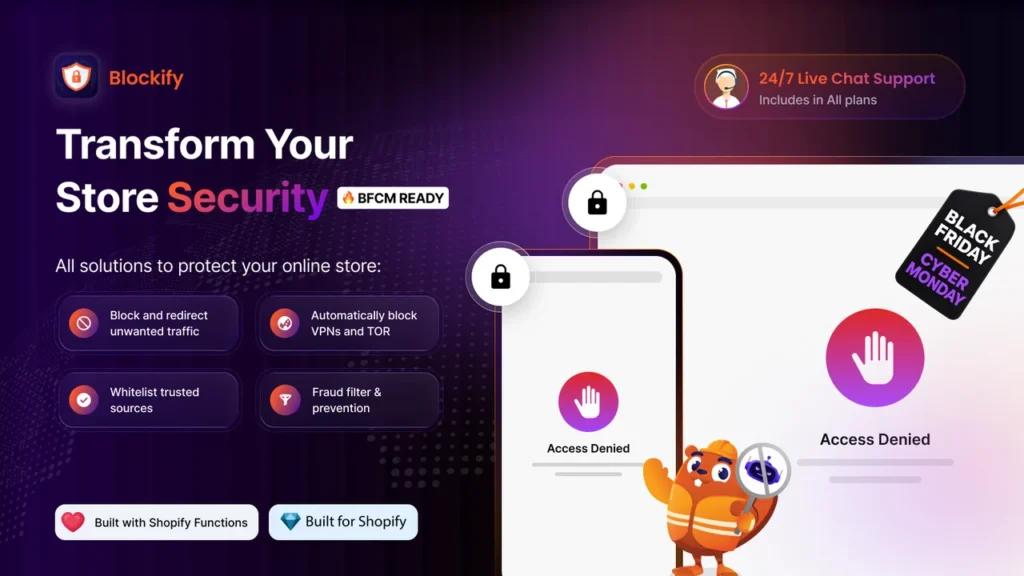
Blockify Fraud Filter, Blocker is a Shopify fraud prevention app by Blockify. On the Shopify App Store, it is listed as “Built for Shopify,” with pricing shown as free to install and paid plans for more advanced rules and analytics.
Blockify’s core promise is store protection through traffic rules, bot control, fraud filters, visitor analytics, content protection, and order-level fraud tools. The app listing describes features such as IP blocking, country blocking, bot blocking, VPN/proxy detection, Tor controls, fraud-order detection, geolocation redirects, checkout blocking, and content-copy prevention.
In plain words, Blockify helps merchants decide who should be allowed into the store, who should be redirected, who should be blocked, and which risky patterns need review.
That makes it useful for stores dealing with:
- Bot traffic during campaigns or launches
- Bots and suspicious sessions behind card-testing attempts
- Fake checkouts
- Repeated low-value suspicious orders
- Visitors from unsupported countries
- VPN, proxy, Tor, or data-center traffic
- Spy tools and basic scraping behavior
- Fraud orders that need filtering or automation
Blockify is especially strong when fraud begins before an order is created. For example, a store may see traffic spikes from countries it does not sell to, bots creating fake checkouts, or repeated visits from the same suspicious IP range. In that case, waiting until Shopify creates a high-risk order is already late. Blockify gives merchants more control earlier in the journey.
What Is Wyllo?
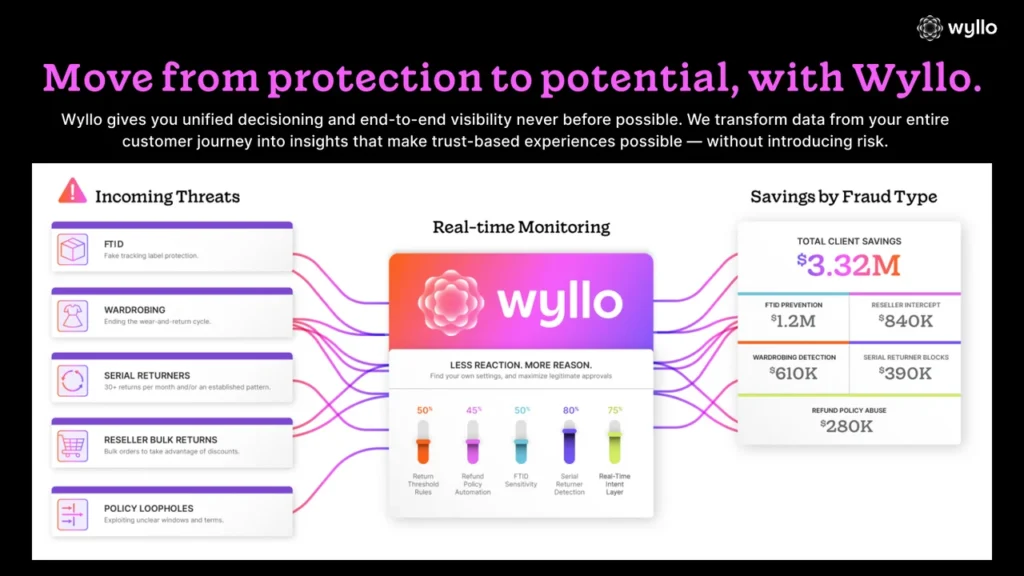
Wyllo (formerly NoFraud), describes itself as a risk intelligence platform that helps merchants manage fraud, policy abuse, and customer experience across the commerce lifecycle. Its listing says it combines identity signals with behavioral intelligence so merchants can make decisions across checkout, returns, refunds, and support.
Wyllo’s listed feature areas include:
- Bot and reseller detection
- Payment fraud protection
- Return fraud and abuse prevention
- Claim and policy abuse prevention
- Customer experience support
- Order validation
- Order hold
- Auto-cancel
- Custom rules
- Blocklists
- Identity verification
- Fraud insurance
- AI-powered detection
- Automated workflows
- High-risk and chargeback alerts
Its pricing structure also shows a different market position. At the time of research, Wyllo offered a screening-only free-to-install plan that can screen up to 100 orders free per month after trial conditions. Its paid guarantee tiers start at 1% of revenue, with a $250/month minimum for merchants under $50K/month revenue. In other words, the merchant pays 1% of revenue, but if that amount is lower than $250, the minimum monthly charge is $250. Stores above $50K/month revenue need to contact Wyllo for custom pricing, which usually puts the app in a higher-budget, managed-risk category rather than a simple rule-based blocker.
Blockify vs Wyllo: What Is the Main Difference?
The biggest difference is where each app gives the merchant control.
Blockify starts with store access and traffic behavior. It helps merchants block, redirect, or whitelist visitors based on conditions such as IP, country, state, city, ISP, referrer, user agent, VPN/proxy signals, Tor, page, product, or collection. It also adds fraud-order analytics, checkout blocking, and Shopify Flow integration for selected order responses.
Wyllo starts closer to risk decisions around orders, payment fraud, identity, returns, claims, and support workflows. It is built for merchants who want risk scoring, verification, optional manual review, and chargeback guarantee options.
Here is the cleaner way to think about it:
| Comparison point | Blockify Fraud Filter, Blocker | Wyllo |
|---|---|---|
| Core angle | Control store access, risky traffic, bots, fraud filters, and checkout blocking | Risk intelligence for fraud, payment abuse, returns, claims, and support |
| Best at | Visitor-level blocking and rule-based prevention before checkout | Order/payment risk decisions and optional guarantee |
| Merchant control | High: rules for block, redirect, whitelist, checkout, visitor logs | Medium to high: custom rules plus platform decisioning and manual review options |
| Main risk layer | Entry, browsing, checkout, and order review | Checkout, payment, post-purchase abuse, returns, claims, and support |
| Pricing style | Lower-cost app plans | Revenue-based guarantee tiers with higher minimum monthly cost |
| Best-fit merchant | Stores seeing bad traffic, bots, fake checkout attempts, country/IP abuse, VPN/proxy traffic | Higher-risk brands that need fraud decisions, chargeback support, and broader abuse analysis |
Neither approach is automatically better. The better choice depends on whether your main issue is unwanted traffic before purchase or risky orders and chargebacks after purchase.
How Do Blockify and Wyllo Compare on Fraud Coverage?
Blockify covers fraud through traffic, connection, behavior, visitor, and order signals. Its Shopify listing groups features under fraud types such as bots, chargebacks, and fake accounts, with prevention tools such as blocklists, geolocation redirects, content protection, spam blocking, bot detection, and fraud filters. Its product page also names scenarios such as bots, fake traffic, card testing, risky orders, spy tools, and fake visitors.
Wyllo covers fraud through identity, payment, abuse, and lifecycle risk. Its Shopify listing includes bots, chargebacks, payments, gift card abuse, and delivery as fraud types. It also lists prevention tools such as order validation, order hold, auto-cancel, custom rules, blocklists, geolocation redirects, identity verification, fraud insurance, AI-powered detection, fraud filters, and automated workflows.
| Fraud scenario | Blockify | Wyllo |
|---|---|---|
| Bot traffic | Strong fit | Strong fit |
| Country/IP blocking | Strong fit | Supported, but not the main positioning |
| VPN/proxy/Tor traffic | Strong fit | May be part of broader risk signals, but less central in public listing |
| Fake checkouts | Strong fit | Strong fit |
| Payment fraud | Supported through fraud filters and high-risk order tools | Strong fit |
| Chargeback risk | Helps reduce exposure by stopping risky traffic and flagging high-risk orders | Strong fit, especially with guarantee tiers |
| Return abuse | Not the main focus | Strong fit |
| Claim and policy abuse | Not the main focus | Strong fit |
| Content copying or spy tools | Strong fit | Not the main focus |
Blockify is stronger for controlling bad traffic before it becomes an order. Wyllo is stronger when fraud risk is tied to order approval, payment review, return abuse, and guarantee-backed workflows.
How Do Blockify and Wyllo Compare on Pricing?
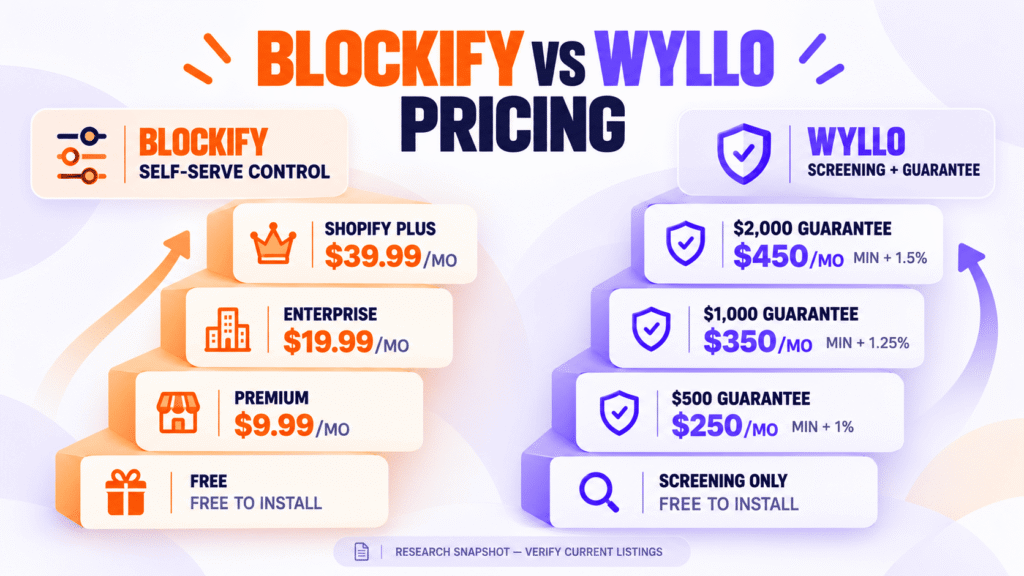
Pricing is one of the clearest differences in the Blockify vs Wyllo decision.
At the time of research, Blockify’s Shopify App Store listing showed lower-cost self-serve plans:
| Blockify plan | Listed price | Notable listed features |
|---|---|---|
| Free | Free to install | 4 block IP/country rules, 4 redirect IP/country rules, first 200 visitors tracked, fraud order analytics |
| Premium | $9.99/month | Unlimited block and redirect IP/country, unlimited visitor analytics, auto-block VPN/proxy, content protection, fraud order analytics |
| Enterprise | $19.99/month | Premium features plus Tor/fraud-order visitor blocking, ISP/referrer URL blocking, checkout conditions, fraud order filters |
| Shopify Plus | $39.99/month | Access to all features, full visitor analytics, auto-cancel high-risk orders, full fraud order analytics, all fraud filters, 24/7 live chat support |
Wyllo’s listing showed higher guarantee-based pricing:
| Wyllo plan | Listed price | Notable listed features |
|---|---|---|
| Screening Only | Free to install | 14-day trial after first screened order, up to 100 screened orders free/month, upgrade path to manual review and guarantee |
| $500 Guarantee | $250/month minimum + 1% of revenue | Fraud chargeback guarantee on orders Wyllo passed, optional expert manual review, optional branded verification |
| $1000 Guarantee | $350/month minimum + 1.25% of revenue | Higher guarantee tier, optional manual review, optional branded verification |
| $2000 Guarantee | $450/month minimum + 1.5% of revenue | Higher guarantee tier, optional manual review, optional branded verification |
Pricing can change, so merchants should verify both Shopify App Store listings before choosing. Still, the pattern is clear: Blockify is priced like a self-serve fraud-control app, while Wyllo is priced more like a fraud decisioning and guarantee platform.
For Enterprise and Shopify Plus Stores, Which App Is Stronger?
Blockify can be a stronger fit for Enterprise and Shopify Plus merchants that want predictable fraud protection costs as they scale.
The reason is that Blockify’s protection is built across several layers of the store journey. Instead of only reviewing risk after an order is placed, Blockify helps merchants control fraud and scammer activity from the start of the visit. It can help protect store traffic, storefront access, content, abandoned checkout behavior, and selected order-risk patterns through rules, analytics, blocking, redirects, whitelists, fraud filters, and checkout controls.
This layered setup matters for larger stores because fraud does not always begin at payment. Bot traffic can distort analytics, scrapers can copy store content, suspicious visitors can create fake checkouts, and risky sessions can reach checkout before the team notices the pattern. Blockify gives Enterprise teams more control earlier in that journey.
The pricing model also makes Blockify easier to plan around. Its Shopify Plus plan is built around a feature package, so larger merchants can access a broader set of fraud, bot, visitor analytics, checkout, and automation features at a more stable monthly cost.
Wyllo’s paid guarantee tiers work differently. They are based on a percentage of revenue, with a monthly minimum for stores under $50K/month revenue and custom pricing above that level. That model can make sense for merchants that want chargeback guarantee and managed fraud review. But for stores with a low fraud rate, the cost of protection can still rise as revenue grows, even if the actual fraud problem does not grow at the same speed.
For Enterprise and Shopify Plus merchants that mainly need stable, rule-based protection across traffic, bots, content, checkout, and fraud patterns, Blockify can be the more cost-predictable option. Wyllo is more suitable when the store wants a managed risk platform tied to payment fraud decisions and chargeback guarantee.
Which App Has Stronger Social Proof?
Blockify has a clearer social proof advantage on the Shopify App Store.
At the time of research, Blockify had a 4.9-star rating from 1,763 reviews, while Wyllo had a 4.8-star rating from 163 reviews. Both ratings are strong, but Blockify has a much larger review base, which gives merchants more public feedback to evaluate before installing.
Blockify also supports more languages and integrations. Its listing shows 9 supported languages and integrations such as Shopify Flow, Klaviyo, and AI Assistant. Wyllo’s listing shows English only and does not highlight the same range of extra integrations.
This does not automatically mean Blockify is the better app for every store. Wyllo may still be a better fit for merchants that need payment fraud screening, manual review, and chargeback guarantee. But for merchants comparing public trust signals, support coverage, and Shopify App Store presence, Blockify has the stronger proof point.
| Comparison point | Blockify Fraud Filter, Blocker | Wyllo |
|---|---|---|
| Shopify App Store rating | 4.9★ | 4.8★ |
| Review volume | 1,763 reviews | 163 reviews |
| Public trust signal | Larger review base, easier for merchants to evaluate from public feedback | Strong rating, but smaller review base |
| Supported languages | 9 languages | English only |
| Shopify Flow | Supported | Supported |
| Klaviyo integration | Supported | Not highlighted on listing |
| AI Assistant / AI-related support | Highlighted in Blockify’s ecosystem/listing signals | Not highlighted on listing |
| Main integration angle | Traffic control, Shopify Flow, Klaviyo, visitor/fraud workflows | Shopify Admin, Checkout, payment and subscription-related tools |
| Best social proof takeaway | Stronger public App Store presence and broader merchant accessibility | More niche positioning for managed risk and fraud decisioning |
Which App Gives Merchants More Direct Blocking Control?
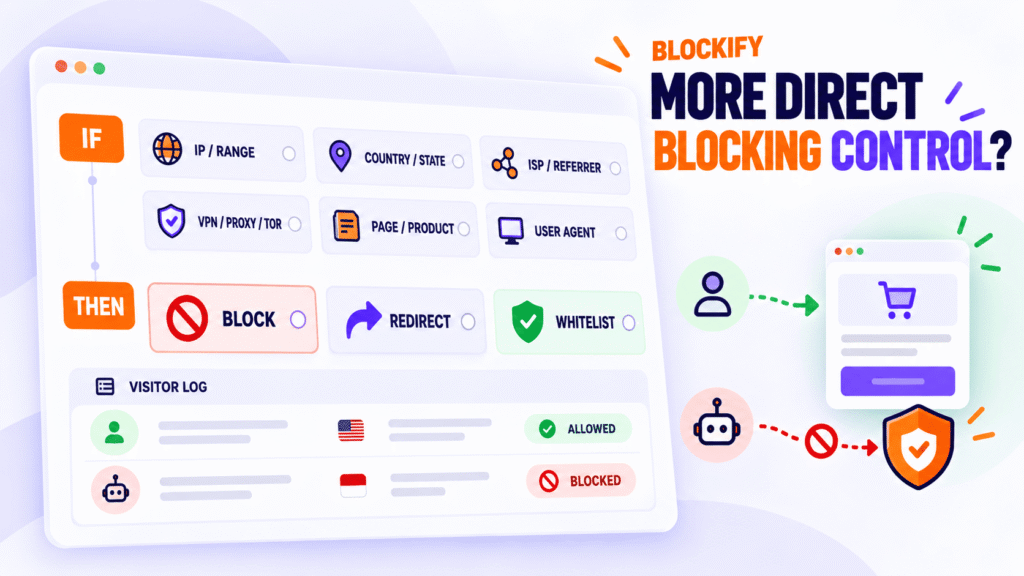
Blockify gives merchants more direct blocking control.
It lets merchants create rules based on IP address, IP range, country, state, product, collection, user agent, page, ISP, referrer, VPN/proxy, Tor, and other visitor signals. Merchants can also block, redirect, or whitelist visitors, then review allowed and blocked visitor logs to adjust the rules.
This is useful when the problem starts before checkout. For example, a store may want to block traffic from countries it does not sell to, allow trusted team members, redirect visitors to a regional page, or stop suspicious visitors from reaching checkout.
Wyllo also supports tools such as blocklists, custom rules, auto-cancel, and automation. But its main focus is broader risk intelligence, not detailed storefront blocking.
So if you want to build and adjust your own blocking rules, Blockify is the stronger fit.
Which App Is Better for Chargeback Protection?
Wyllo is better for chargeback protection if you mean fraud screening, manual review, and optional chargeback guarantee.
Wyllo’s plans include guarantee tiers for fraud chargebacks on orders it passes. It also offers payment fraud protection, expert manual review, and branded verification.
Blockify can still help reduce chargeback risk, but in a different way. It helps merchants stop suspicious traffic, risky visitors, VPN/proxy activity, fake checkouts, and high-risk patterns earlier. That can reduce exposure before a bad order reaches fulfillment.
So the answer depends on the need:
| Chargeback-related need | Better fit |
|---|---|
| Fraud chargeback guarantee | Wyllo |
| Expert/manual review | Wyllo |
| Payment fraud screening | Wyllo |
| Earlier control over risky traffic | Blockify |
| Blocking VPN/proxy/Tor, countries, IP ranges, and fake checkouts | Blockify |
| Lower-cost prevention before orders are created | Blockify |
Which App Is Better for Bot Traffic and Fake Visitors?
Blockify is better for bot traffic and fake visitors.
Its features are built around blocking or redirecting visitors by IP, country, ISP, referrer, URL, VPN/Tor, and data-center traffic. It also supports bot blocking, visitor analytics, spam blocking, and content protection.
This matters because bots do not only create fraud risk. They can also inflate sessions, distort ad data, trigger fake checkouts, scrape content, and make campaign reports harder to trust.
Wyllo also lists bot and reseller detection. But if the main problem is fake traffic hitting the storefront, Blockify is easier to match to that use case.
Which App Is Better for Return Abuse and Policy Abuse?
Wyllo is better for return abuse and policy abuse.
Its listing directly mentions return fraud, claim abuse, policy abuse, refunds, and customer support context. That makes it more relevant when the problem happens after the order, such as refund abuse, repeat claims, or suspicious return behavior.
Blockify is not mainly a return-abuse app. Its strengths are traffic control, bot blocking, fraud-order analytics, fraud filters, and checkout risk controls.
So if the issue is return or claim abuse, choose Wyllo. If the issue is suspicious traffic before checkout, choose Blockify.
How Do the Apps Compare for Shopify Native Workflow?
Both apps support Shopify workflows, but they fit different operations.
Blockify works well when merchants want to connect fraud signals to actions inside Shopify Flow. For example, a team can get notified when an order is blocked or flagged for review.
Wyllo also works with Shopify Flow and Shopify Admin, and it lists integrations such as PayPal, Recharge, Shop Pay, Skio, Stay AI, and Yotpo Subscriptions. That makes it stronger for brands with subscription, payment, and customer lifecycle workflows.
For a simpler Shopify store, Blockify may be enough. For a subscription or high-risk brand with more complex fraud, payment, return, and support workflows, Wyllo may fit better.
When Should You Choose Blockify?
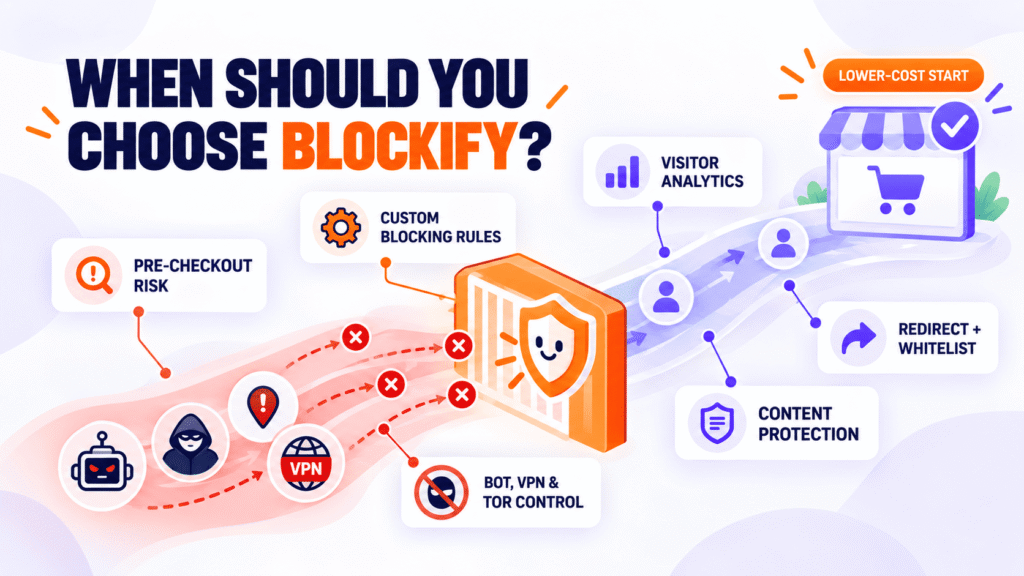
Choose Blockify Fraud Filter if your main problem starts before or around checkout.
Blockify is a strong fit when:
- You need to block countries, states, cities, IPs, IP ranges, ISPs, referrers, pages, products, or collections.
- You want to block or review VPN, proxy, Tor, or data-center traffic.
- Bot traffic is distorting your analytics.
- You see fake accounts, fake checkouts, or card-testing attempts.
- You want visitor analytics before creating broad block rules.
- You need redirect and whitelist options, not only hard blocking.
- You want to let good bots such as search and social crawlers through.
- You want content-protection tools to deter basic copying and spy behavior.
- You need a lower-cost prevention layer before moving to a larger risk platform.
Blockify is also a good fit for merchants who want to stay in control: review, block, redirect, whitelist, and refine.
When Should You Choose Wyllo?
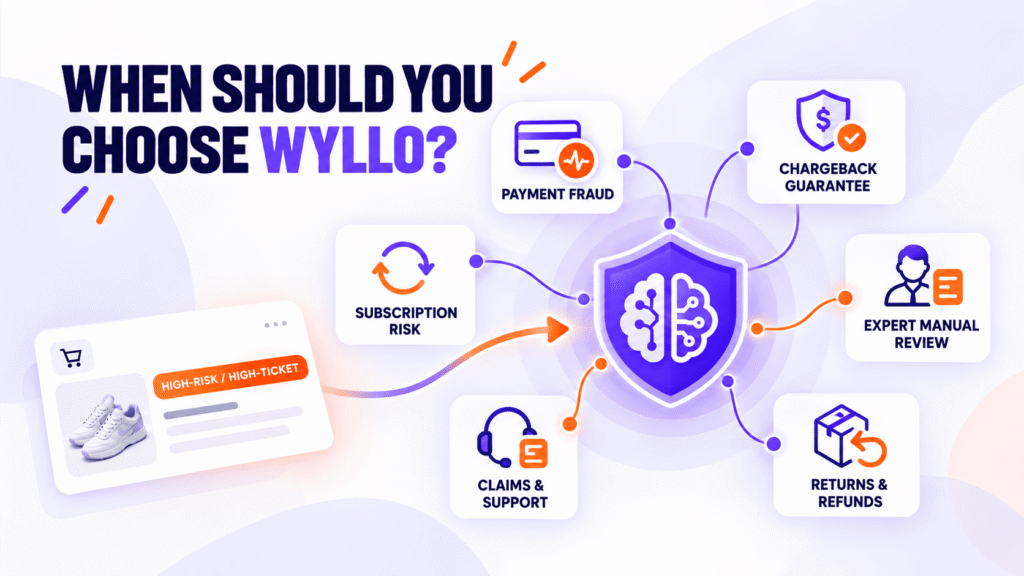
Choose Wyllo if your store needs deeper fraud decisioning, guarantee-backed payment fraud protection, or risk context beyond checkout.
Wyllo is a strong fit when:
- Your main concern is payment fraud and chargebacks.
- You sell high-ticket or high-risk products.
- You want optional fraud chargeback guarantee support.
- You want expert manual review or branded verification options.
- You need risk insight across checkout, returns, refunds, claims, and support.
- You manage subscription workflows and want integrations with tools such as Recharge, Skio, Stay AI, or Yotpo Subscriptions.
- Your team wants a broader risk platform rather than a storefront blocking tool.
The trade-off is cost. Wyllo’s paid plans start much higher than Blockify’s public Shopify pricing, which may be hard to justify for stores that mostly need IP, country, bot, or VPN blocking.
Blockify vs NoFraud: Is NoFraud the Same as Wyllo?
For this comparison, yes. NoFraud rebranded to Wyllo in March 2026 after acquiring Yofi, so users searching for Blockify vs NoFraud are now likely comparing Blockify with Wyllo’s current risk intelligence platform.
Shopify’s current app listing uses the name Wyllo, while the app URL still contains “nofraud-chargeback-prevention-and-protection.” The listing also describes the product as “Wyllo (NoFraud + Yofi),” which confirms the connection between the old NoFraud name and the current Wyllo brand.
That also makes Wyllo relevant for merchants looking for a NoFraud alternative, especially if they want payment fraud screening, chargeback guarantee, manual review, return abuse detection, and broader risk intelligence.
Final Verdict: Blockify vs Wyllo
For Blockify vs Wyllo, the better choice depends on where fraud starts in your store. If the problem begins before checkout, with bad traffic, bots, VPN/proxy visitors, suspicious locations, fake checkouts, or risky sessions, Blockify is the stronger fit.
If the problem starts after an order is placed, Wyllo may make more sense. It is better suited for payment fraud screening, chargeback guarantee, manual review, return abuse, and broader risk intelligence.
You can also use both apps in a layered setup. Blockify can filter risky traffic before checkout, so Wyllo has fewer suspicious orders to review after checkout. This works best for higher-risk stores that need both front-door control and deeper order-level fraud decisioning.
In short, choose Blockify when you need more control before checkout. Choose Wyllo when you need deeper fraud decisioning after checkout. Use both only when your fraud problem clearly spans both stages.
