The eCommerce customer journey has become increasingly complex, with shoppers jumping between channels, comparing products, reading reviews, and expecting seamless experiences. Understanding this journey and mapping it clearly helps brands improve conversions, strengthen loyalty, and remove friction across every touchpoint.
| In this article, you’ll learn: ● What the eCommerce customer journey really is ● Why mapping the journey matters for conversion and loyalty ● The 5 key stages shoppers go through ● How to build an effective customer journey map ● Practical ways to improve the journey in 2026 |
The eCommerce client journey is the full path that a customer walks, from knowing your brand to buying and returning as a loyal customer. It embraces all the interacting situations they have, like navigating through products, performing comparisons, paying, and interacting after buying.
The customer journey is not linear as shoppers switch between several channels and devices. Knowing it gives you the power to identify friction, enhance pivotal moments, and deliver a seamless experience that transforms visitors into confident buyers.
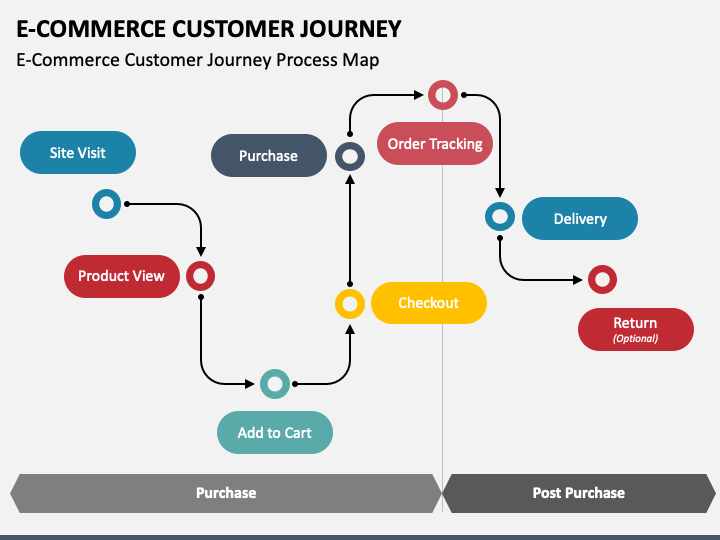
Customer journey mapping is essential, as it provides valuable insights into the path shoppers take, their decision influencers, and the areas where friction occurs. Instead of making assumptions about user drop-off or conversion reasons, you obtain a crystal clear, well-organized view of their actual experience from awareness to the post-purchase stage.
Key reasons it’s important:

e-Commerce shopping journey is much more than just a series of clicks; it is a behavioral process that involves motivation, trust, friction, and perceived value. Knowing the stages helps brands to create customer interactions that not only reduce drop-offs but also increase conversions and loyal customers in the long run.
Below is a deeper look at the five foundational stages.
This is the moment when shoppers get to know your brand and generally are not in the mood for purchase. The discovery is done through various channels such as paid advertisements, organic search, influencer content, marketplaces, email, social media, or word-of-mouth. At this point, the shopper is determining the relevance, not comparing products.
Brands come out victorious in the Awareness stage, when they express their uniqueness very vividly, communicating either their value proposition, pricing advantages, category fit, or emotional resonance. Great creative, attractive hooks, and a seamless brand identity help the brand embed itself in the consumer’s memory. The objective here is not conversion but attention, recall, and perceived relevance.
In this situation, the shopper transitions from merely noticing your products to evaluating them. They carry out a comparison between your products and the competitors, read the reviews, take a close look at the features, and at the same time check the reliability of your store. The risk reduction plays a significant role in most cases: customers are looking for assurance that the product will not only be as good as they expect, but also the company that sells it.
Quality UX is a key factor; user-friendly navigation, strong filtering, and detailed product pages, along with FAQs, sizing guides, return policies, user-generated content (UGC), and clear pricing, all result in cognitive load being lessened. The competition has been relegated to merely sitting back and watching as soon-to-be customers discuss the pros and cons of a purchase with reference to risk factors, the riskier ones, and their desires being factors.
Purchase is the “critical conversion moment,” where motivation is highest, but drop-off risk is also highest. Even small points of friction, a slow-loading checkout, limited payment options, unclear field errors, and unexpected fees, can push users away.
An optimized checkout for conversion reduces the number of steps, utilizes autofill wherever possible, accepts various payment methods (PayPal, Shop Pay, BNPL), and clearly shows trust signals and guarantees. This part calls for perfect operation: your systems, UX, trust, and logistics all come together here. The brands with smoother checkout flows are the ones that consistently enjoy higher conversion rates and lower CAC.
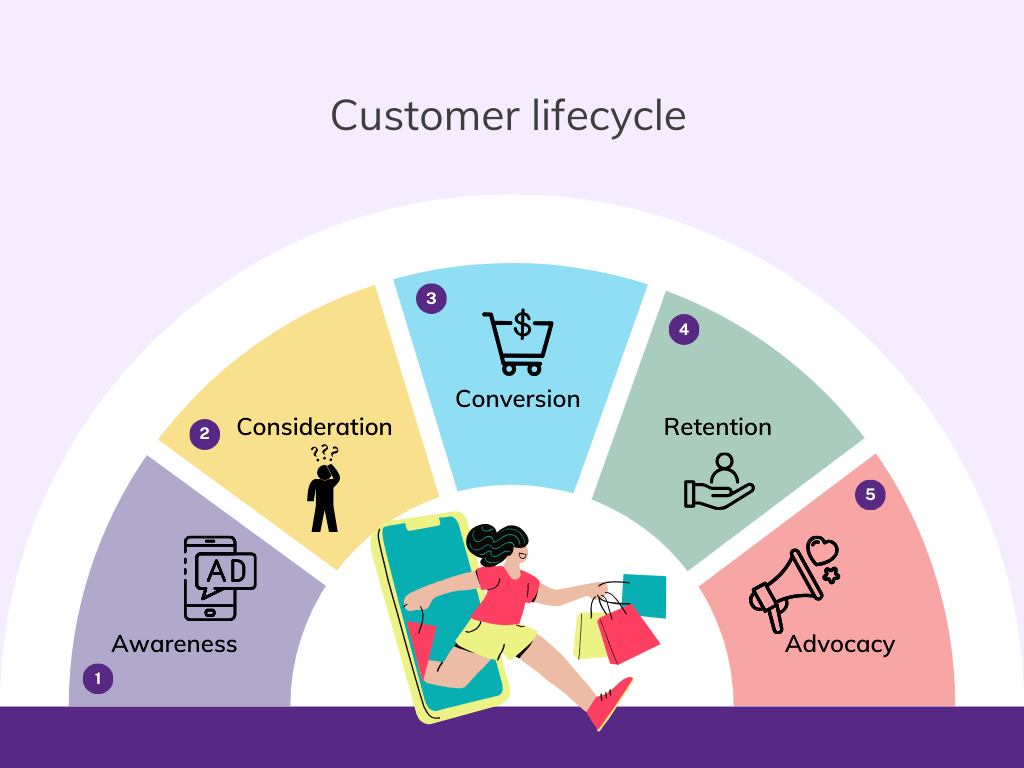
The period after the purchase is when a good number of brands lose the trust of their customers. Delivery speed, shipment visibility, packaging quality, and problem resolution, all these factors, greatly influence the customers’ overall assessment of the experience. Even if the product is flawless, a poor delivery would still spoil the whole journey.
Expectations of the shoppers are transparency, real-time tracking, proactive communication, and hassle-free return processes. Fulfillment is also a loyalty lever: smooth, predictable delivery builds reliability, while inconsistent logistics erode satisfaction and repeat rate. Modern CX focuses heavily on reducing anxiety between “I paid” and “I received.”
Once the product is delivered and used, customers reassess the entire experience and decide whether your brand deserves repeat business. Loyalty isn’t created by discounts; it’s earned through emotional satisfaction, consistent quality, and thoughtful post-purchase touchpoints.
Personalized follow-up emails, loyalty rewards, review requests, proactive support outreach, and tailored product recommendations all strengthen retention. Returning customers have higher LTV, lower acquisition cost, and stronger advocacy impact, making this the most profitable stage of the journey. Brands that invest here outperform competitors relying only on new traffic.
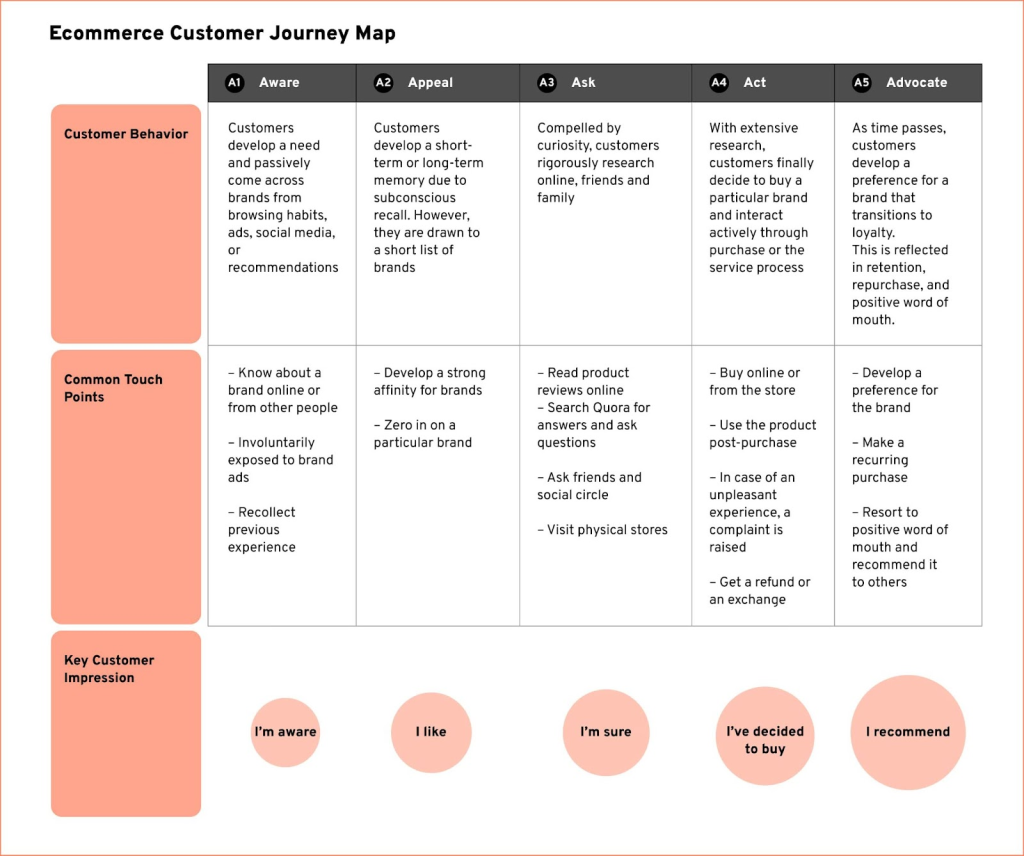
A customer journey map is an effective visualization of the process that customers go through in your online store. It additionally gives insight into their thought process and also marks the interactions they had with your pages and through the different touchpoints.
When you know these steps, you can enhance the experience and finally lead customers to your desired outcomes.
Here is an example of how the journey map is structured.
First, before any journey mapping, stakeholders should come together and agree on the purpose of the mapping process and the application area of the map.
It is necessary to find out first if the map is going to be used for reducing cart abandonment, diagnosing checkout friction, improving onboarding for new users, or increasing customer lifetime value. Setting clear goals will determine the extent and direction of the analysis.
Instead of mapping all the areas of focus at once, it’s better to concentrate on a strategic slice like the product discovery route, the PDP-to-cart transition, or the post-purchase onboarding experience. Wider scope areas do not yield as much as actionable insights and quick wins as the narrowed ones.
Effective journey maps rely on accurate representations of real shopper behavior, not assumptions.
Combine CRM insights, GA4 behavioral patterns, heatmaps, session recordings, and customer service reports to create personas rooted in real evidence.
Outline each persona’s demographics, buying motivations, anxieties, value drivers, technological comfort level, and triggers that move or halt their progress. Sophisticated maps also include decision criteria and behavioral heuristics (e.g., discount-driven, research-heavy, convenience-focused).
To bridge the gap between data collection and execution, feed these insights into a Buyer Persona Creator. This ensures your mapping process is driven by synthesis rather than subjective interpretation.
A complete map requires understanding both what shoppers do and where they do it.
Define the Core Stages:
Most eCommerce journeys follow five macro phases:
Inventory Every Interaction:
Document every click, scroll depth, chat request, email open, support ticket, and even micro-interactions like hover behavior or form auto-fills. This reveals hidden friction zones that traditional funnel reporting often misses.
A journey map is not going to deliver anything if it is devoid of the emotional context. The aim here is to get to know not only shoppers’ activities but also the reasons behind such behaviors.
Analyze the results of your Voice of Customer (VoC) surveys, Net Promoter Score (NPS) comments, and support transcripts, as well as the data from the post-purchase interviews, that help you identify the times where customers are experiencing doubt, frustration, or the opposite of delight.
Identify high-exit pages, dead clicks, rage clicks, bottlenecks in checkout, coupon-fail events, or repeat user loops that indicate confusion. Tools like heatmaps, GA4 funnel reports, and struggle detection make these patterns visible.
Turn all insights into a structured, accessible visual that stakeholders can interpret at a glance.
Choose the Right Mapping Approach:
Build a Mapping Grid:
Horizontally list the key stages; vertically layer actions, thoughts, emotions, opportunities, and operational constraints. This grid becomes a cross-functional reference for product, CX, marketing, and engineering teams.
A journey map is only valuable if it informs decisions and evolves with the business.
Internal teams should simulate the customer’s end-to-end path to uncover inconsistencies in messaging, UX errors, trust gaps, or broken flows that data alone doesn’t reveal.
Map the routes, pick those with the highest potential ROI/ROAS, and optimizations, for example, like navigation simplification, cognitive load reduction on PDPs, or trust badges and delivery guarantees during checkout to be added.
Customer patterns show changes in the wake of a new campaign, the introduction of a new device, technology, or simply market trends. The process of reviewing quarterly is a hassle-free way to ensure that the journey map is always precise and strategic.
The process of improving discovery has a transformation of search at its core. AI-powered search recognizes users’ browsing habits and thus offers personalized results, which makes the first contact smooth rather than stressful.
Besides, social platforms are becoming the main channels for discovery: TikTok, Instagram, and live shopping stimulate spontaneous, in-feed purchases without the necessity of setting foot on your site. Furthermore, voice search is still on its way up, and thus making your content easy to find for natural, dialogue-like queries will keep you in the limelight as hands-free shopping becomes more popular.
When shoppers evaluate products, clarity builds confidence. High-quality visuals, 360° images, and AR tools reduce hesitation by helping customers “experience” items digitally.
Furthermore, social proof strongly influences decisions; UGC is trusted up to 2.4× more than branded images, making reviews and customer photos essential. And because hesitation often leads to abandonment, proactive live chat or AI assistants can answer questions instantly, easing users toward a decision rather than letting them drift away.
The point of sale is where the consumer’s intention to buy is strongest, and at the same time, the barriers are most significant. Guest checkout, one-click payments, and fewer form fields can all work to make the process smoother and keep the customers coming.
Also, payment methods such as Buy Now Pay Later (BNPL) make it easier for people to overcome their price doubts, while shorter forms and the use of autofill increase the likelihood of completion. When the checkout process is perceived as quick and certain, buyers seldom reconsider their choice.
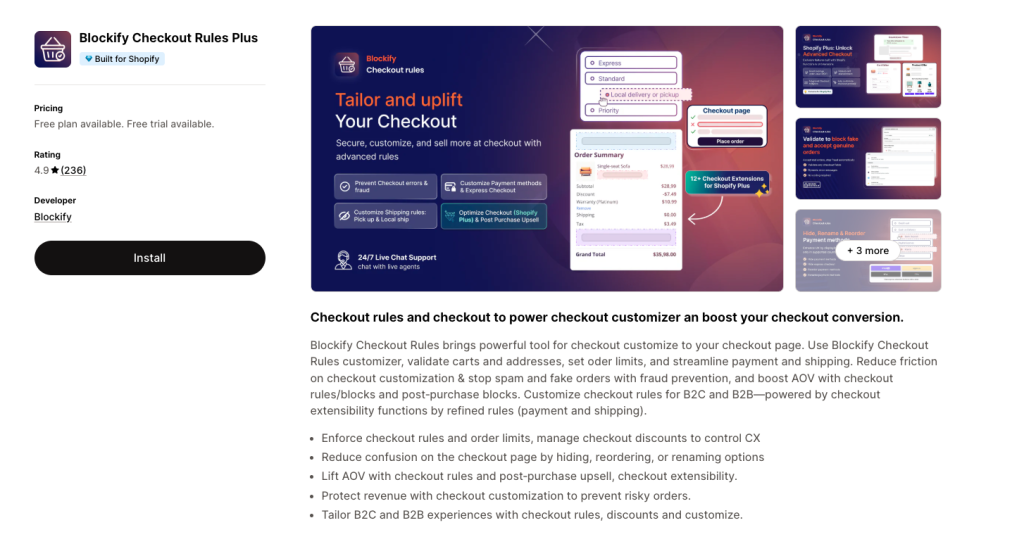
Once the checkout flow is stable, there’s also room to improve its value. Some brands use tools like our Blockify Checkout to show contextual upsells, such as faster shipping or upgraded packaging, only to verified, low-risk customers.
Post-purchase is where long-term loyalty is formed. Real-time SMS or WhatsApp updates reduce anxiety and set clear expectations, while branded tracking pages let you control the experience.
However, returns can quickly harm loyalty if they’re complicated. Self-service portals, quick exchanges, and flexible credit options turn returns into opportunities rather than setbacks. And when loyalty programs adapt to each customer’s habits, rewards feel personal instead of generic, driving repeat purchases.
Behind every smooth journey lies strong technical performance. A mobile-first layout ensures your entire store feels natural on smaller screens, where most browsing now happens.
In addition, speed matters; even a 100ms improvement can raise conversion rates by ~1%. And because 90% of shoppers consider security a key factor, visible trust badges and transparent data policies directly influence buying confidence.
Security plays a critical role in the eCommerce customer journey. When shoppers feel their data, payments, and browsing experience are protected, they are far more likely to trust the store and complete a purchase.
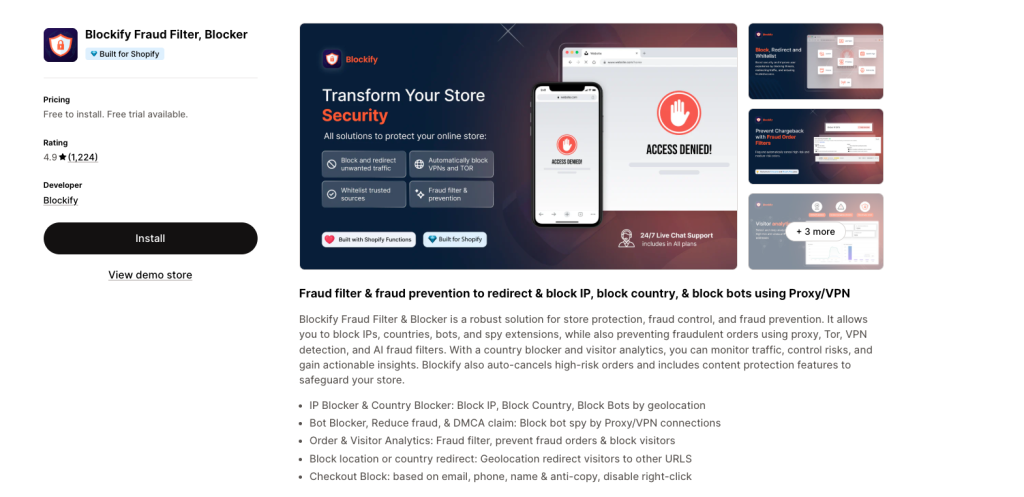
However, online stores today face growing risks such as bot traffic, fraud attempts, fake orders, and malicious visitors. Using a store protection solution like Blockify Fraud Filter helps merchants detect suspicious behavior, block harmful traffic, and strengthen fraud control and fraud prevention, creating a safer and more reliable shopping environment for both businesses and customers.
Tiredness caused by slow website performance, product information not so clear, lengthy checkout stages, limited payment options, and poor post-purchase communication.
Monitor the vital statistics, including the conversion rate, cart abandonment rate, customer satisfaction (CSAT), repeat purchase rate, and time required for checkout completion.
Do this every 3-6 months, or as and when major changes like new features, customer behavior shifts, or updated marketing channels occur.
Conclusion
One strong eCommerce customer journey is made from small, seamless moments that are little by little added up. When discovery is easy, checkout is smooth, and post-purchase is nurturing, customers will come back naturally.
Read More: eCommerce Customer Experience: Definition & How to Improve It