If you’re running an online store, you’ve probably heard the term eCommerce conversion rate. Simply put, it tells you how many of your website visitors actually make a purchase. And the truth is, even a small improvement in this rate can lead to big revenue gains.
| What you’ll learn in this article: ● Industry, device, and country benchmarks in 2025 ● Actionable tips to boost your eCommerce conversion rate ● Key metrics and tools to track your CRO performance |
Your eCommerce conversion rate shows how many visitors actually take the desired action, like making a purchase, signing up for a newsletter, or adding a product to the cart.
To calculate it, use this simple formula:
Conversion Rate = (Number of Conversions ÷ Total Visitors) × 100
For example, if your store had 500 sales and 10,000 visitors in a month, your conversion rate would be:
(500 ÷ 10,000) × 100 = 5%
That means 5% of your traffic turned into paying customers.
According to Shopify, a solid eCommerce conversion rate usually falls between 2% and 4%. That said, what counts as “good” can differ greatly depending on your industry, product type, and business model, so it’s more meaningful to benchmark against similar stores than rely solely on the global average.
It’s important to measure your conversion rate against your own performance over time, not just against industry averages. Improving site speed, checkout flow, and mobile UX often delivers the biggest gains. Even a 0.5% increase in conversion rate can translate into a significant revenue lift for stores running paid campaigns.
Compiled from recent benchmark reports by Adobe, ConvertCart, and OptiMonk, global eCommerce conversion rates vary significantly depending on device type, industry, traffic source, and geographic region:
Conversion rates differ greatly depending on product type and buying behavior. Below are average benchmarks sorted from highest to lowest:
| Industry | Avg. Conversion Rate |
|---|---|
| Food & Beverage | ~6.0% |
| Health & Beauty / Personal Care | ~4.5% |
| Consumer Goods | ~4.0% |
| Multi-Brand Retail | ~4.0% |
| Electronics & Appliances | ~3.6% |
| Fashion & Apparel | ~3.0% |
| Pet Care | ~2.5% |
| Home & Furniture | ~1.3% |
| Luxury & Jewelry | ~1.0% |
| Automotive / High-Ticket Goods | <1.0% |
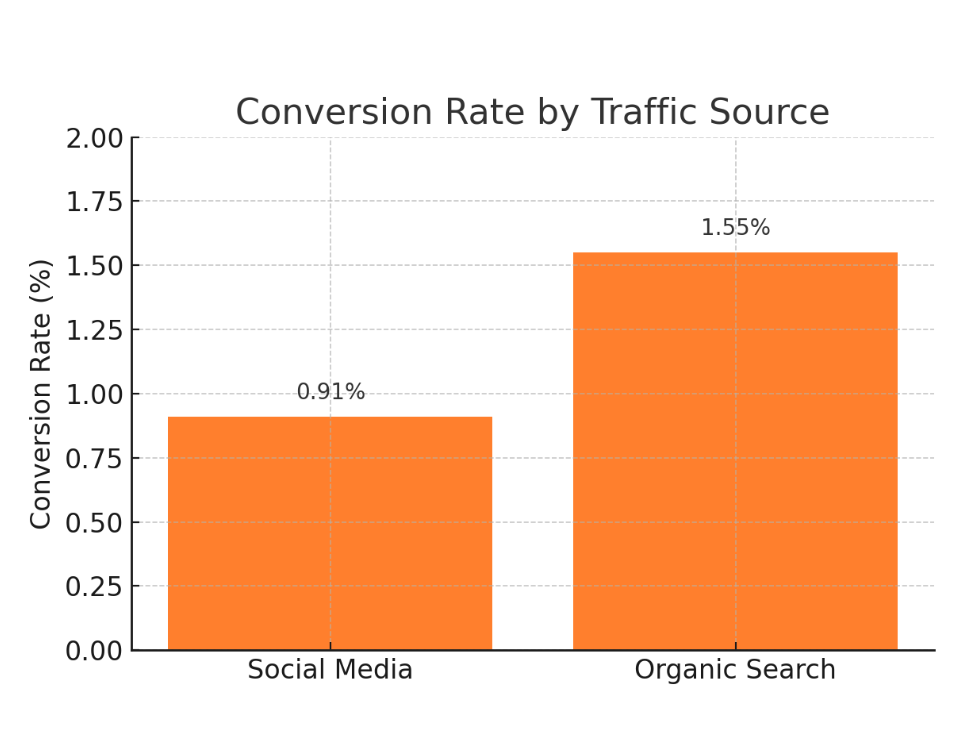
Each traffic source performs differently when it comes to driving conversions, recognizing these patterns allows for smarter marketing allocation.
Take social media, for instance. It tends to generate the lowest conversion rates, averaging just 0.91%. This may be because users on these platforms are typically in a passive browsing mode, not actively looking to buy.
In contrast, organic search traffic converts better at around 1.55%, though it still falls short of the overall average.
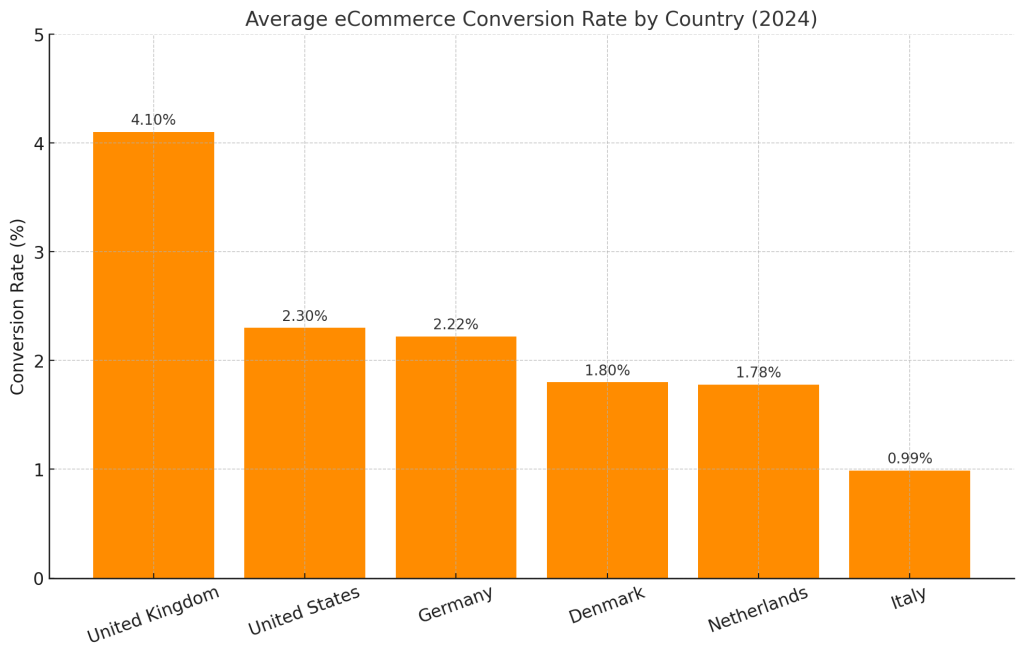
Conversion rates vary widely across countries due to differences in shopping culture, payment options, and device usage. For instance, some markets prefer researching online but completing purchases in store, while others shop entirely online.
Because of this, comparing your store’s performance with global averages alone can be misleading, region‑specific data gives you sharper insight.
Here are some example country figures from 2024:
eCommerce takes place across many touchpoints, with shoppers engaging on various devices, which means your conversion rates will often vary depending on whether they browse via desktop, mobile, or tablet.
| Device | Approx. Conversion Rate |
|---|---|
| Desktop | ~3.2% |
| Mobile | ~2.8% |
| Tablet | ~3.1% |
Small tweaks can lead to big wins. If your traffic’s steady but sales feel stuck, it’s time to rethink the way your store converts visitors into customers.
Shoppers don’t wait. If your store takes more than 3 seconds to load, many users will bounce before they even see a product.
That’s why site speed is one of the first things you should optimize. Compress images, remove unused scripts, and use a reliable hosting provider to shave off loading time.
A long, confusing checkout process kills conversions. People want to buy, not fill out endless forms.
Instead, streamline the steps. For example, allow guest checkout, reduce the number of fields, and make sure it’s easy to go back and edit information.
Buyers hesitate when they’re unsure about returns, shipping, or data privacy. Even if they love the product, doubt can stop the purchase.
To ease this, display your return policy, shipping info, and trust badges in visible places. That extra clarity reassures shoppers and reduces cart abandonment.
Even the best-converting stores are vulnerable if fraud slips through. High-risk orders, bot traffic, or VPN-based attacks can ruin your margins before you notice.
To defend your store, use tools like Blockify Fraud Filter & Blocker. It helps you block suspicious IPs, countries, bots, and even auto-cancel risky orders at checkout, keeping your conversion clean and your revenue real.

People can’t touch or try your product online, so visuals need to do the heavy lifting. Blurry or generic photos won’t cut it.
For better results, invest in clear, well-lit images and consider adding a short demo video. Additionally, showing the product in real-life settings helps boost confidence.
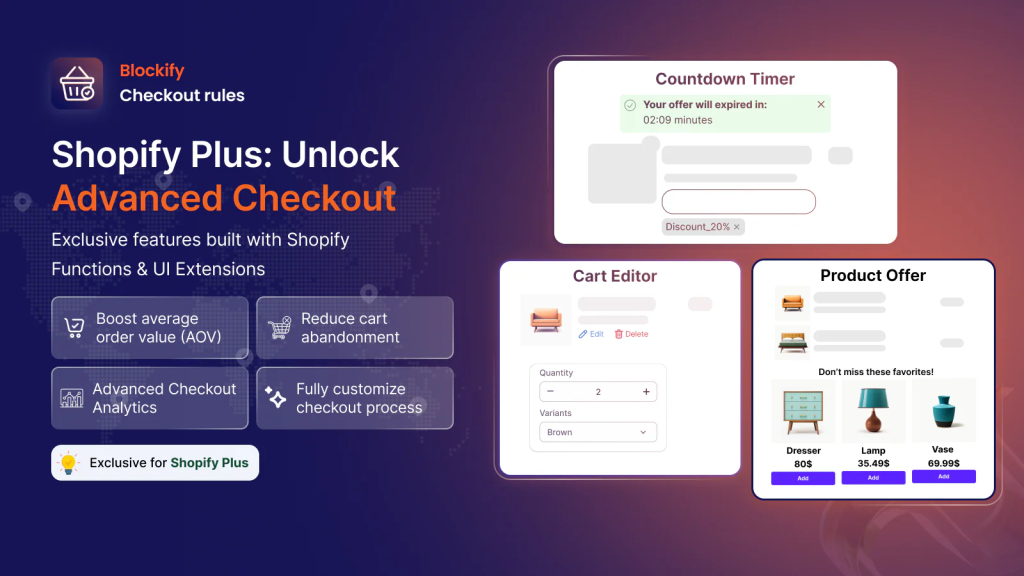
Urgency motivates action. A time-limited deal gives shoppers a reason to buy now instead of later.
To make this work, highlight countdown timers or flash sale banners on your site. Just be careful not to overuse them, or they’ll lose their power.
Showing the right product at the right time can make all the difference. Generic suggestions rarely convert well.
That’s why you should use browsing behavior or purchase history to tailor recommendations. Over time, this kind of personalization can boost both conversion and AOV.
With over 60% of eCommerce traffic coming from mobile, your store needs to look and work great on small screens.
Therefore, test mobile usability regularly. Buttons should be easy to tap, text readable, and checkout seamless from any device.
The checkout page is one of the highest-intent steps in the buying journey, making it a perfect spot to lift AOV without disrupting the flow.
With Shopify Plus, tools like Blockify Checkout Rules Plus let you enable native checkout upsells that feel seamless to shoppers.
Its Product Offer on the Order Status Page allows you to display relevant add-ons or upgrades right after payment, a small touchpoint that often delivers a surprisingly strong boost in post-purchase revenue.
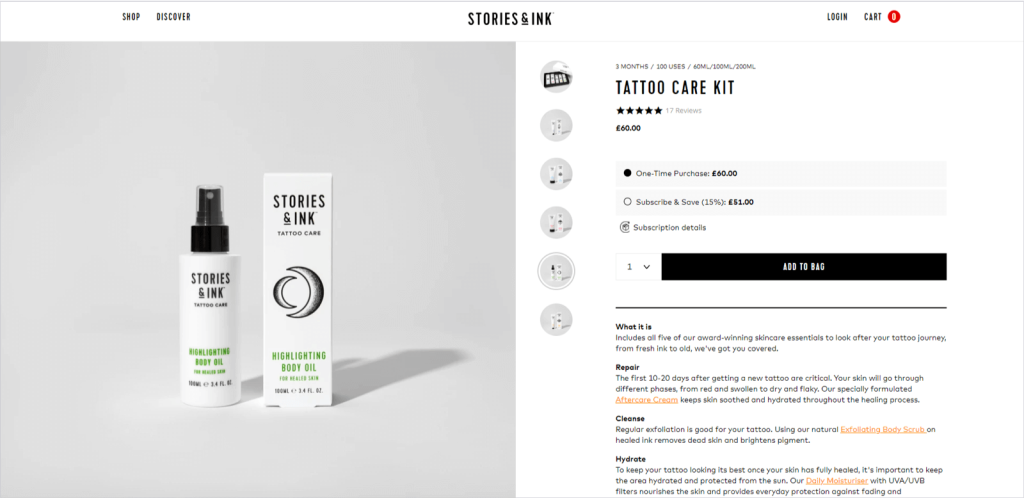
Social proof builds trust fast. Real feedback from real people helps others feel more confident in their purchase.
So if you’re not already collecting reviews, start now. And make sure to display them near the product, not buried on a separate tab.
Directing visitors to your shop is merely a part of the struggle; the real profit will come from the conversion of the traffic that the store gets. This is the point where eCommerce CRO (Conversion Rate Optimization) acts as a savior. It enables you to accumulate revenue by turning your current visitors into customers without any additional spend on ads.
📊 According to Adobe’s 2024 report, stores that regularly run CRO tests see up to 50% higher conversion rates compared to those that don’t.
Here’s why optimizing your conversion rate matters:
🔮 Looking ahead to 2026
It is anticipated that ad prices will go up, the rivalry will become fiercer, and AI-based consumer behavior will alter the way shoppers use eCommerce sites. Companies crying out for help that do not consider CRO as a priority will face hard times trying to stay on the profitable side. On the other hand, those that are constantly optimizing will be the ones to enjoy the stability of year-over-year growth, even with no significant increase in traffic.
Conclusion
Improving your eCommerce conversion rate isn’t about chasing random trends; it’s about understanding your customers, tracking key metrics, and optimizing each step of the buyer journey. From tailoring experiences by device to analyzing traffic sources and fine-tuning your sales funnel, every detail counts.
Whether you’re seeing 6% conversions in food & beverage or struggling below 1% in luxury goods, what matters most is consistent testing and improvement. Start small, track your data, and remember: even a 0.5% increase in your ecommerce conversion rate can make a big difference in your revenue.